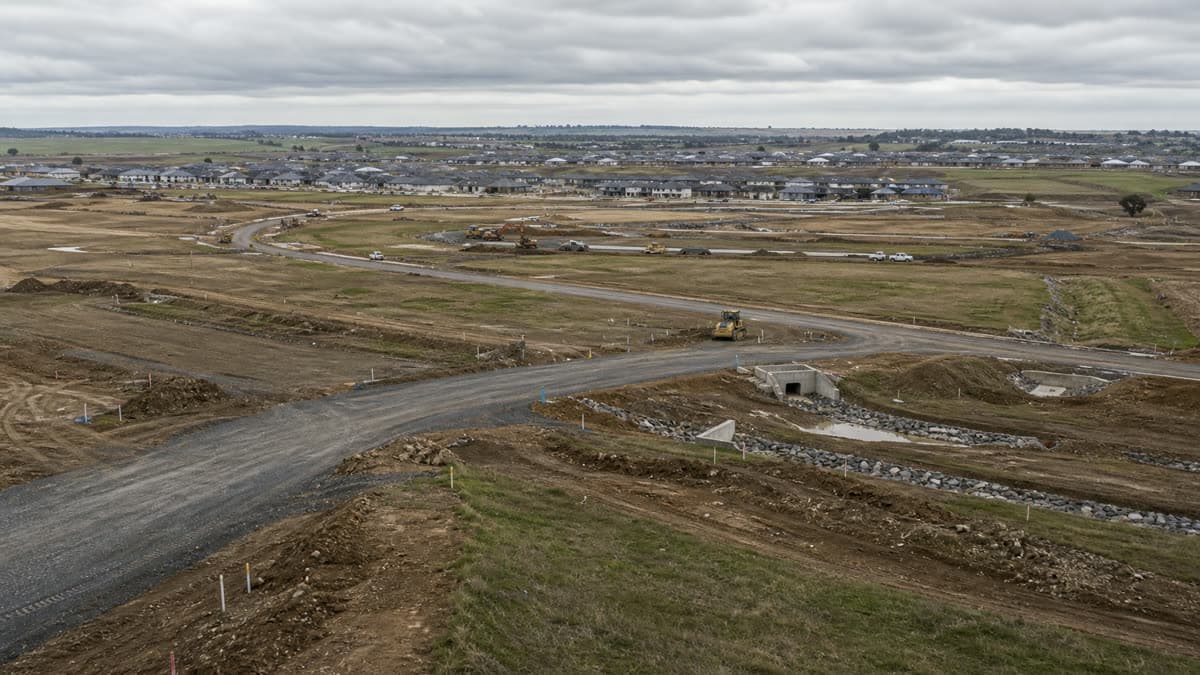
 Photo: SiteLogic editorial image
VPA
Clyde South and Derrimut Fields: what two VPA PSP phases mean for land timing
The VPA's current project pages place Clyde South in third-party funding and Derrimut Fields in background studies and content. That phase difference matters because it changes how much planning certainty a growth-area feasibility can honestly assume.
Growth-area land can look similar on a broker map and sit in very different planning positions once you read the Victorian Planning Authority source pages. That is the practical lesson from Clyde South in Casey and Derrimut Fields in Melton. Both are live VPA precincts. Both sit inside the same broad greenfield pipeline. But the VPA's current project list places Clyde South in Third Party Funding and Derrimut Fields in Background Studies and Content.
That is not a cosmetic status label. It is a signal about what can be assumed in a feasibility, how much programme confidence is available, and where the next delay is most likely to appear.
What changed
The official VPA project pages show the two precincts moving through different parts of the same PSP system.
For Clyde South, the VPA says it is preparing a precinct structure plan and infrastructure contributions plan for a 1057 hectare precinct in Casey. The project list currently records Clyde South in the Third Party Funding phase. The Clyde South July 2025 status update says planning is underway following the government's May announcement, that the VPA had assembled its project team, and that its next focus was securing the funding needed to progress the work through landowner contributions.
For Derrimut Fields, the VPA page says the precinct is in Melton and is bounded by Christies Road, Boundary Road, Hopkins Road and Middle Road. The main project page says the VPA had begun the pre-commencement phase and was seeking expressions of interest for third-party funding. The later April 2026 status update goes further. It says the VPA had finalised the pitching report and Vision and Purpose statements, that technical studies were underway, and that procurement was progressing for the remaining studies. The project list now records Derrimut Fields in Background Studies and Content.
Read together, those sources show the commercial difference clearly. Clyde South is still carrying a funding-step risk before the full study programme is settled. Derrimut Fields has moved past that point and into the study and content stage that shapes the eventual plan.
What applies
The VPA's own process material explains why those labels matter. Its Precinct Structure Planning Guidelines say PSP preparation follows the PSP 2.0 approach, with early work focused on shared vision, resolving planning challenges early and then building the technical and policy content needed for the precinct plan. Its third-party funding material says technical assessments, stakeholder consultation and the planning scheme amendment work are funded through a combination of VPA resources and, in some projects, voluntary landowner funding agreements.
The third-party funding FAQ is direct on mechanics. The VPA says those agreements are contracts with participating landowners, typically costed on a per-hectare basis with staged payments over the PSP process. Another VPA FAQ is direct on timing risk: where sufficient up-front funding cannot be secured, the VPA may defer or not proceed with preparation until funding is available, and later funding can still mean commencement is rescheduled if resources have already moved elsewhere.
That means a site inside a precinct shown as third-party funding is not in the same planning position as a site inside a precinct where background studies are already underway. In the first case, the project still carries a threshold question about funding certainty and programme timing. In the second case, the threshold has largely shifted to what the studies will show about transport, servicing, biodiversity, heritage, water, staging and infrastructure cost.
Neither phase is close to permit-ready. But they create different kinds of risk, and that matters when a land buyer decides how much timing confidence belongs in the acquisition model.
How to model it
The simplest mistake is to treat every VPA-listed PSP as if it is merely waiting for gazettal. The VPA sources do not support that shortcut.
For a precinct still in third-party funding, the conservative assumption is that planning direction exists but the detailed programme remains vulnerable to funding and resourcing delay. In practical terms, that means the feasibility should not assume a fixed PSP completion window merely because the project has a named precinct page. If the project timeline only works because rezoning and structure planning happen by a certain quarter, that assumption needs a discount for stage risk.
For a precinct that has moved into background studies and content, the programme position is stronger, but the modelling focus changes rather than disappears. Once technical studies are underway, the risk is less about whether the project can start and more about what the evidence base will require. A PSP can still narrow the net developable area, alter drainage land, change arterial interfaces, reserve community facilities, identify biodiversity constraints or reshape staging in ways that affect yield and timing.
The useful discipline is to separate three lines in the model.
First, carry a stage-risk allowance. For a third-party funding precinct, that allowance belongs against programme timing because the VPA says insufficient funding can defer or halt progress. For a background-studies precinct, the allowance belongs more against study outcomes and sequencing.
Second, carry a planning-content sensitivity. The VPA's funding material lists the kinds of studies that inform a PSP: biodiversity, Aboriginal cultural heritage, bushfire, land capability, transport, integrated water management, infrastructure costings and related work. Those are not abstract planning exercises. They are the inputs that can reduce yield, move roads, enlarge easements or change subdivision staging.
Third, carry a contributions placeholder. Clyde South is expressly being prepared with an infrastructure contributions plan, and the VPA process explains that PSP work and ICP work sit together. Derrimut Fields is also a PSP project where later infrastructure funding settings will matter. Even before the final numbers exist, a greenfield feasibility should leave room for future contributions rather than treating them as an afterthought.
What to check before exchange
First, read the VPA project list and the precinct's own status updates together. The list gives the phase label. The status page usually explains what that label means in real work terms.
Second, test whether the deal depends on a specific planning date or only on long-run urbanisation. If the acquisition price only makes sense when the PSP reaches a fixed milestone quickly, a third-party funding precinct deserves extra caution.
Third, identify the risk that sits behind the current phase. For Clyde South the current public record points to funding and programming. For Derrimut Fields it points to study outcomes and the content of the future plan.
Fourth, do not confuse a live VPA precinct with an approved development framework. Until the PSP and associated planning controls are completed and implemented, the project is still in a planning process, not at the end of one.
Finally, write the assumption down. If the land value depends on the precinct progressing from third-party funding to technical studies within a short period, say so in the acquisition note. If the yield depends on future study outcomes being benign, say that too. Hidden assumptions are what make growth-area land deals look safer than they are.
The main takeaway is not that one precinct is good and the other is bad. It is that the VPA's phase labels are commercially useful if you read them literally. Clyde South and Derrimut Fields are both active precincts, but they are active in different ways. A sound feasibility should price that difference rather than flattening both sites into the same generic "future PSP" category.
Published by the SiteLogic Editorial desk. Every fact traces to a primary source. See our standards and corrections register.
Fact-checked: 17 June 2026 · Review by: 17 June 2027
Sources: Victorian Planning Authority - Project List · Victorian Planning Authority - Clyde South · Victorian Planning Authority - Project Status Update - July 2025 (Clyde South) · Victorian Planning Authority - Derrimut Fields · Victorian Planning Authority - Project Status Update - April 2026 (Derrimut Fields) · Victorian Planning Authority - Precinct Structure Planning Guidelines · Victorian Planning Authority - What are Third Party Funding Agreements and how are the contributions calculated? · Victorian Planning Authority - What happens if sufficient funding cannot be secured for a voluntary third party funded PSP?
Was this useful? Try the tool this post is based on:
Pro on SiteLogic. Logi: up to 60 messages a day. Logi also stops at US$15 of model cost in a Melbourne calendar month. The Developer Comms Kit and unlimited saved projects. The Strategy Lab simulator runs without Pro. Saving a scenario needs a signed-in account. $60/month or $600/year, ex GST. First 3 months are $30/month, ex GST, on monthly Pro.