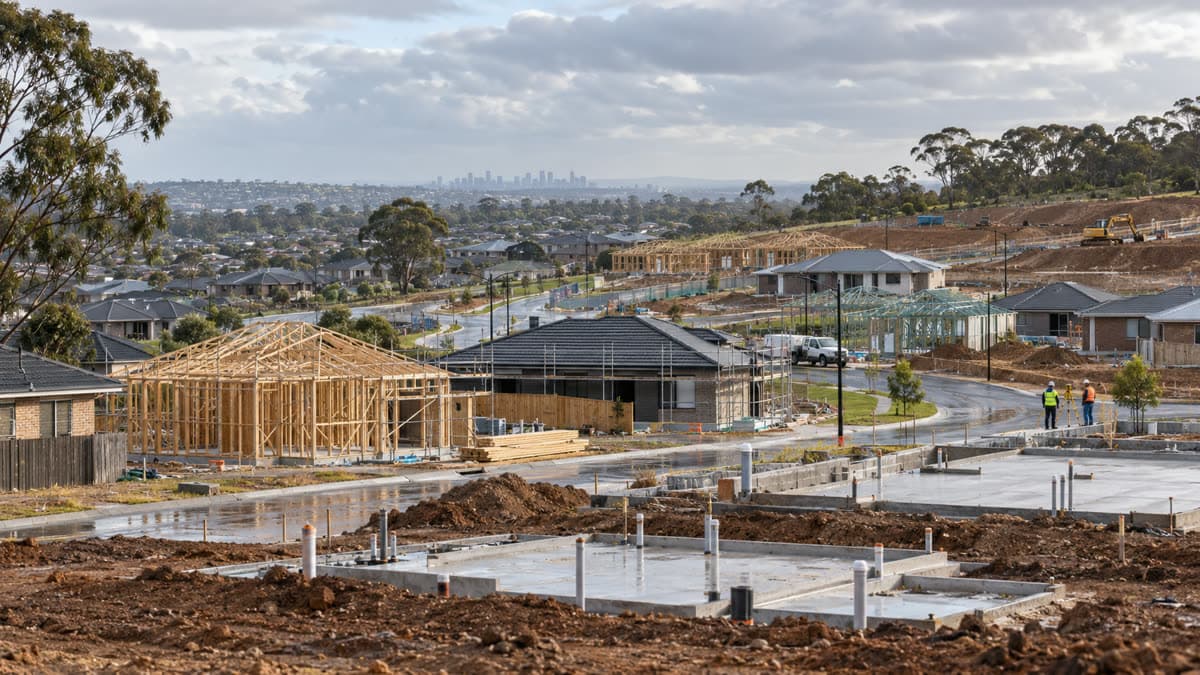
 Photo: SiteLogic editorial image
Building Approvals
Victorian dwelling approvals: what the ABS series says about the pipeline
Victorian building approvals rose in August 2026 on the seasonally adjusted series, but apartments and townhouses lag houses over twelve months. This article reads the ABS data and shows what higher rates do to the decision to start.
A building approval is permission to build. It is not a start, and it is not a completion. The ABS approvals series is an early public signal of Victoria's housing pipeline, and it is worth reading with that gap in mind.
This article uses the ABS Building Approvals release for August 2026, published on 30 September. This article was written on 3 October from that edition. Later releases may have revised its figures, so check the ABS page for the current numbers. The ABS release page lists the September 2026 edition for early November.
What the August figures show
On the seasonally adjusted series, Victoria approved 5,163 dwellings in August, up 8.9% on July. Private sector houses made up 3,044 of those. The trend estimate for total dwellings was 4,942, down 1.8% on the month.
Nationally, total approvals fell 6.1% in August to 16,953, and private sector dwellings excluding houses fell 21.2% to 5,674. Victoria's 5,163 is about 30% of the national total, so its rise came against a falling national figure.
Monthly figures in a single state jump around. A large apartment approval can lift one month and vanish the next. The twelve-month totals are steadier.
The ABS also revises. The August release added 2 dwellings to Victoria's 2025-26 total and 74 to its 2026-27 total. Recent months are provisional, so a figure you quote today can move by the next release. Three versions of each series exist: the original count, the seasonally adjusted series and the trend estimate. The original series is the actual count of approvals. The other two are modelled, and the trend estimate is the smoothest.
Twelve months, houses against everything else
The table adds up the ABS monthly original series for Victoria, all sectors. It compares the twelve months to August 2026 with the twelve months before. The sums are SiteLogic's, taken from the ABS data tables.
| Dwellings approved | 12 months to Aug 2025 | 12 months to Aug 2026 | Change | |---|---|---|---| | Houses | 32,604 | 34,836 | +6.8% | | Dwellings excluding houses | 23,127 | 22,172 | -4.1% | | Total | 55,731 | 57,008 | +2.3% |
Dwellings excluding houses are apartments, townhouses and units. They fell from 41.5% of Victorian approvals to 38.9%. Projects of that kind commonly rely on debt and presales.
The longer view helps. The ABS trend estimate for total Victorian approvals was 4,942 in August 2026. Its lowest reading since the start of 2019 was 3,947 in April 2023, and its highest was 6,320 in July 2021. Today's trend sits about 25% above the low and about 22% below the peak.
What approvals do not tell you
The ABS publishes starts separately, in Building Activity, Australia, each quarter. The March 2026 quarter showed 48,012 dwellings commenced nationally on the seasonally adjusted series, down 11.2%. Private sector other residential commencements fell 20.7% to 19,116 on the quarter, although they were up 5.6% on the year. Those figures are from the March 2026 quarter edition, released on 8 July. A later quarterly edition may show different numbers.
Those numbers are national, and one quarter is not a pattern. They are a reminder that an approval is not a start. The RBA's August Statement on Monetary Policy projected dwelling investment growth turning negative during 2027. That is the RBA's projection, not an outcome.
The 29 September statement said new housing loans had declined noticeably. Finance conditions sit between an approval and a start.
Worked example: the cost of waiting
The following figures are illustrative. They demonstrate the method and will vary by site, council and timing.
A developer holds an approved 12-townhouse site. Land cost is $3,000,000, funded 70% by debt.
- Debt: $3,000,000 × 0.70 = $2,100,000.
- Interest at 8.10% (a 4.60% cash rate plus 3.5 points): $2,100,000 × 0.0810 = $170,100 a year, or $14,175 a month.
- Interest at 8.35% after another 25 basis points: $2,100,000 × 0.0835 = $175,350 a year, or $14,613 a month.
- Extra cost of the rise: $438 a month.
- Cost of a six-month delay at 8.10%: $14,175 × 6 = $85,050.
That sum excludes land tax, council rates and consultant fees. A permit does not stop the meter. Every month spent re-pricing presales or retendering the build adds to the holding line. A site that passes feasibility at one rate can fail at the next if the delay is long enough.
What to check
- Use the twelve-month sum. Monthly seasonally adjusted figures for Victoria are volatile.
- Split houses from the rest. Your competition for buyers comes from the second group.
- Read starts and lending beside approvals. Not every approval becomes a start.
- Check your permit conditions. Confirm when your permit expires if works have not started.
- Compare against a year ago. The Vic development conditions panel shows approvals and housing loans against the prior year.
- Re-run the holding line. Update the rate, the debt share and the number of months you expect to wait.
This is general information and not financial advice.
Published by the SiteLogic Editorial desk. Every fact traces to a primary source. See our standards and corrections register.
Fact-checked: 3 October 2026 · Review by: 3 January 2027
Sources: abs.gov.au · abs.gov.au · rba.gov.au · rba.gov.au
Was this useful? Try the tool this post is based on:
Pro on SiteLogic. Logi: up to 60 messages a day. Logi also stops at US$15 of model cost in a Melbourne calendar month. The Developer Comms Kit and unlimited saved projects. The Strategy Lab simulator runs without Pro. Saving a scenario needs a signed-in account. $60/month or $600/year, ex GST. First 3 months are $30/month, ex GST, on monthly Pro.