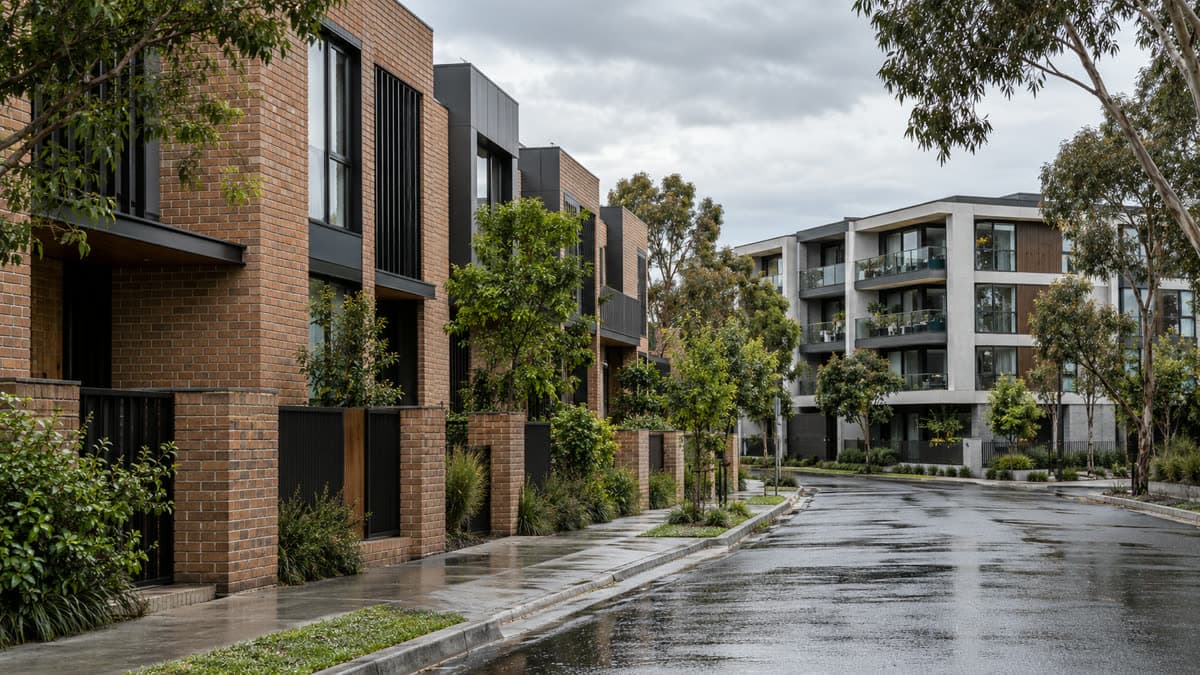
 Photo: SiteLogic editorial image
Interest Rates
Townhouses or apartments: which product carries higher rates better
Interest cost scales with the average balance and the time it is carried. This article compares a small townhouse project with an apartment building to show which absorbs a rate rise better, and what lenders look at.
Developers often ask which product is safer when rates rise. The question has a mechanical answer and a commercial one, and they point in slightly different directions.
The mechanical answer starts with one line of arithmetic. Interest equals the average drawn balance, times the rate, times the years the balance is carried. A project with a large facility held for a long time is exposed to rates in a way a small, quick project is not.
The mechanical test: balance-years
Call the average balance multiplied by the years carried "balance-years". Every 100 basis points on the rate costs 1% of the balance-years. That gives a direct measure of rate exposure that is independent of the rate itself.
The RBA's cash rate table shows the cash rate target at 4.60% from 30 September 2026, after four rises of 25 basis points this year. SiteLogic's default holding rate is the cash rate plus a 3.5 point lender margin: 8.10%.
A worked example
The following figures are illustrative. They demonstrate the method and will vary by site, council and timing.
Townhouse project. Six townhouses at $1.15m each, so gross realisation is $6.9m. A $3.5m facility averaging 55% drawn over a 14-month programme.
- Balance-years: $3,500,000 × 55% × (14 ÷ 12) = $2,245,833.
- Interest at 8.10%: $2,245,833 × 8.10% = $181,913. That is 2.6% of gross realisation, or about $30,300 a dwelling.
- Each 100 basis points: $22,458. That is 0.33% of gross realisation, or about $3,740 a dwelling.
Apartment project. Forty apartments at $850,000 each, so gross realisation is $34.0m. A $22.0m facility averaging 55% drawn over a 30-month programme.
- Balance-years: $22,000,000 × 55% × 2.5 = $30,250,000.
- Interest at 8.10%: $30,250,000 × 8.10% = $2,450,250. That is 7.2% of gross realisation, or about $61,300 a dwelling.
- Each 100 basis points: $302,500. That is 0.89% of gross realisation, or about $7,560 a dwelling.
Per dollar of sales, the apartment building is 2.7 times as sensitive to the rate ($302,500 ÷ $34.0m against $22,458 ÷ $6.9m). Two inputs drive that: a longer programme and a larger share of revenue borrowed.
Those inputs are assumptions. A tight apartment programme with a lower facility could narrow the gap. The method still holds: compute balance-years for your own project.
The commercial test: what protects the revenue
Interest is only half the equation. The other half is how firmly the sale prices are fixed.
Lenders to apartment projects commonly set a presale requirement before they fund. Check yours. The RBA's October 2026 Financial Stability Review reports that, with strong lender competition, some lenders had lowered presale requirements for residential developments and loosened some covenants, while other terms were largely unchanged. It adds that lenders have been more discerning on project fundamentals, including location, and have engaged with established builders and developers. Higher construction costs and affordability constraints have also shrunk the pool of feasible projects.
Presales lock a contract price. They also create a settlement risk that sits with the developer. Consumer Affairs Victoria notes that off-the-plan buyers pay a deposit of no more than 10%, that the contract price does not change even if the property value moves during the build, and that a lower value at settlement can make loan approval harder. If rates rise during a 30-month programme, buyers who signed at the start are tested at settlement under conditions that did not exist when they signed.
A small townhouse project may be able to sell on or near completion. That avoids settlement risk on early contracts but leaves the developer exposed to whatever the market pays when the project finishes. Check with your lender what presale cover, if any, it requires for a project of your size.
Reading the two tests together
- Townhouses, in this example, carry less interest per dollar of sales and have a short exposure window. The risk sits in the exit price.
- Apartments, in this example, carry more interest per dollar of sales and a long exposure window. Presales lock prices, and the risk shifts to valuation shortfalls and buyer finance at settlement.
Neither product wins every time. A townhouse scheme with a thin margin and a weak local market can fail on price. A well-presold apartment building with a fixed-price construction contract can hold up. What the arithmetic does show is that, on these assumptions, the apartment building needs a larger margin to carry the same rate rise, because its balance-years are larger relative to its sales.
What to check
- Compute balance-years for your own drawdown schedule, not a rule-of-thumb average.
- Run the rate sensitivity at plus 50 and plus 100 basis points and express each as a share of gross realisation.
- For apartments, find out when buyers will be tested for finance and what the lender's settlement valuation test is.
- For townhouses, test the sale price at completion against a lower figure. The RBA's 29 September statement noted that housing prices had fallen in most capital cities.
- Ask whether a longer programme for either product could be shortened.
This article is general information and not financial advice.
Published by the SiteLogic Editorial desk. Every fact traces to a primary source. See our standards and corrections register.
Fact-checked: 3 October 2026 · Review by: 3 January 2027
Sources: rba.gov.au · rba.gov.au · consumer.vic.gov.au · rba.gov.au
Was this useful? Try the tool this post is based on:
Pro on SiteLogic. Logi: up to 60 messages a day. Logi also stops at US$15 of model cost in a Melbourne calendar month. The Developer Comms Kit and unlimited saved projects. The Strategy Lab simulator runs without Pro. Saving a scenario needs a signed-in account. $60/month or $600/year, ex GST. First 3 months are $30/month, ex GST, on monthly Pro.