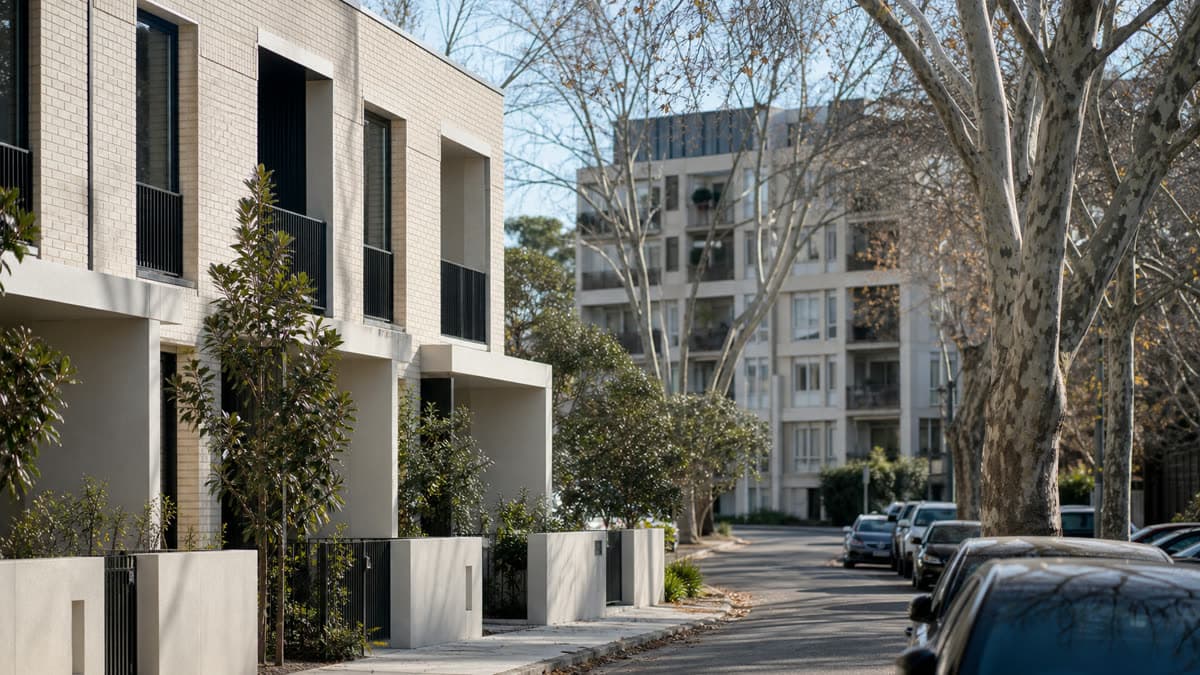
 Photo: SiteLogic editorial image
Feasibility
Townhouse versus apartment margin in the middle ring
Townhouses and apartments can occupy the same middle-ring site but carry different construction risk, sales risk and margin profiles under Clause 58 and general residential standards, and the comparison needs its own feasibility.
A well-located middle-ring site zoned for medium density can often support either a townhouse scheme or a low to mid-rise apartment building, and the choice between the two products is rarely a straightforward comparison of unit numbers. The two typologies carry different construction costs, different regulatory pathways, different sales risk, and often a materially different margin once every cost line is accounted for. A developer defaulting to whichever product maximises yield on paper, without stress-testing the risk and cost profile behind that yield, can end up choosing the wrong product for the site and the market it will sell into.
Two products, one site
Townhouses and apartments can occupy the same envelope on paper, expressed as a dwelling yield per square metre of site area, but the two are built and sold differently, and carry different risk through the construction and sales program. Townhouses are typically delivered as a small number of larger dwellings built using more conventional low-rise construction methods, often staged, with titles issued progressively. Apartments concentrate a larger number of smaller dwellings into a single building, usually requiring a single construction contract, a single completion date, and a sales program that needs enough presales locked in before the bank will fund the build. The apartment format usually lifts yield on a given site, but it changes the risk profile of the project in ways a simple per-dwelling revenue comparison will not show.
Construction cost and risk profile
Low-rise townhouse construction generally uses more familiar trades and a build method contractors have priced many times over, which tends to produce tighter cost certainty and a shorter build program per stage. Apartment construction above a few storeys introduces different requirements: structural transfer, fire engineering, common services, lifts, and a construction program that runs as one continuous project rather than staged releases, concentrating cost and program risk into a single outcome instead of spreading it across stages. A cost blowout or a program delay on a townhouse stage can often be absorbed by adjusting the remaining stages. The same blowout on an apartment building affects the entire project at once, because there are no later stages to reprice.
The Clause 58 overlay on apartments
Apartment developments in Victoria are assessed against the requirements in VPP Clause 58, which sets standards for apartment developments covering matters such as building layout, internal amenity, communal space and energy performance that do not apply in the same form to a townhouse scheme assessed under the general residential standards. Meeting these standards affects the achievable floor plate efficiency and can constrain how tightly a building can be packed onto a site, which in turn affects both construction cost per saleable square metre and the achievable yield. A feasibility comparing a townhouse and an apartment scheme on the same site should model each against its own applicable standard rather than assume the same efficiency ratio applies to both.
Sales risk and absorption
Townhouses typically sell to owner-occupiers and appeal to a buyer who wants a house-like product without the size or cost of a detached home, a market that tends to absorb steadily rather than needing to sell in a single window. Apartments, particularly in a larger building, often need to presell a substantial proportion of the project before a lender will fund construction, which means the sales and settlement risk is concentrated into the period before the build even starts. A softening market during that presale window can stall an apartment project at the point of finance approval, whereas a townhouse scheme staged across a longer program has more scope to adjust pricing or timing on later stages in response to the same market signal.
Margin and risk-adjusted return
A higher unit yield on paper does not automatically mean a higher margin once construction cost, statutory contributions, professional fees for the more complex design and approvals process, and a longer or more concentrated finance drawdown are all built into the apartment scheme's cost stack. The raw margin percentage on an apartment project can look comparable to or better than a townhouse scheme on the same site, but the risk carried to achieve that margin, concentrated construction risk, concentrated presale risk, and a longer single approvals and construction timeline, is materially higher. A developer comparing the two products should look at margin relative to the risk profile and the capital tied up for the duration of the project, not the headline percentage alone.
A worked comparison
The following figures are illustrative. They demonstrate the method and will vary by site, council and timing. On an illustrative 1,200 square metre middle-ring site, a townhouse scheme yields 10 dwellings with an illustrative gross realisation of $8.5 million and a total development cost, including land, of $7.1 million, an illustrative margin of $1.4 million delivered in two staged releases over roughly 18 months. An apartment scheme on the same illustrative site yields 24 units with an illustrative gross realisation of $14.4 million and a total development cost, including land, of $12.7 million, an illustrative margin of $1.7 million, but delivered as a single presale-dependent project over a longer program of around 30 months, with the entire margin exposed to one construction contract and one presale campaign rather than spread across stages.
Reading current market data before choosing
Neither product should be chosen on a static assumption about achievable sale prices. Valuer-General Victoria's property sales statistics report sale prices by dwelling type for each municipality, and a feasibility should check the current trend for each product type in the relevant LGA rather than apply one growth assumption to both, since the two buyer pools, owner-occupiers for townhouses and a mix of owner-occupiers and investors for apartments, do not always move together.
Choosing the product
The right product for a site depends on how much concentrated risk the developer, and the developer's financier, are willing to carry for the incremental margin the higher-yielding product offers. A developer with a strong track record and reliable presale channels may reasonably prefer the apartment format for the yield uplift. A developer more sensitive to program risk, or working with a smaller or first-time lender, may find the staged townhouse format a more reliable path to the same site's underlying value, even at a lower headline margin. Either way, the comparison needs to be run properly, product by product, against the site's actual planning controls and the market it will sell into, rather than settled by the yield number alone.
Published by the SiteLogic Editorial desk. Every fact traces to a primary source. See our standards and corrections register.
Fact-checked: 19 July 2026 · Review by: 19 July 2027
Sources: land.vic.gov.au · planning-schemes.app.planning.vic.gov.au
Was this useful? Try the tool this post is based on:
Pro on SiteLogic. Logi: up to 60 messages a day. Logi also stops at US$15 of model cost in a Melbourne calendar month. The Developer Comms Kit and unlimited saved projects. The Strategy Lab simulator runs without Pro. Saving a scenario needs a signed-in account. $60/month or $600/year, ex GST. First 3 months are $30/month, ex GST, on monthly Pro.