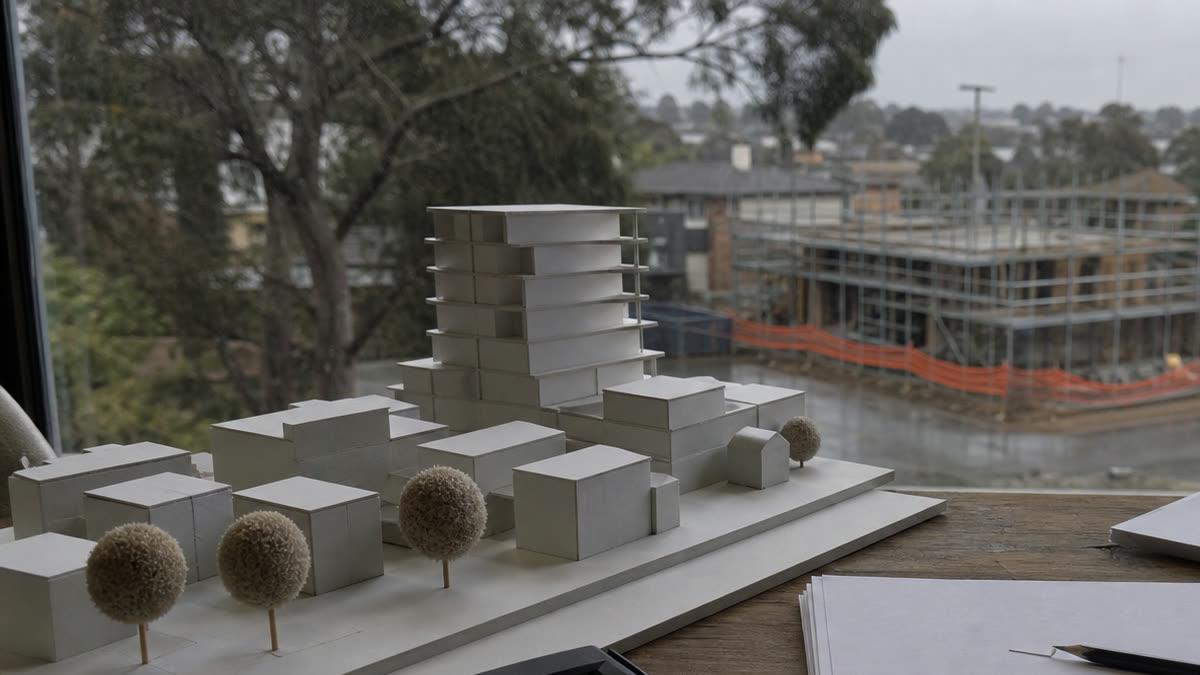
 Photo: SiteLogic editorial image
Feasibility
Stress-testing a Victorian feasibility model
Why a single base-case feasibility understates risk, and how to build a sensitivity matrix across cost, price, rate and timing for a Victorian medium-density site.
What applies
Most feasibility models a developer runs before committing to a Victorian site are single-point estimates: one construction cost figure, one sale price schedule, one interest rate, one program. That single base case tells you whether the project clears its hurdle return under the conditions assumed on the day the model was built. It tells you almost nothing about how much room there is before the project stops clearing that hurdle, and a site bought on the strength of a base case alone is a site bought without knowing where the floor is.
A stress test replaces the single point estimate with a matrix. Instead of asking "does this project work," it asks "under which combinations of cost, price, interest rate and timing does this project stop working, and how far away are we from those combinations right now." The inputs that matter most in a medium-density feasibility are the ones most exposed to movement between the date you model the site and the date you settle the last dwelling: construction cost, sale price, the cost of debt, and the program itself.
Two of those inputs are directly observable at a macro level and worth anchoring to published data rather than gut feel. The cost of debt across the economy is set by the Reserve Bank's cash rate target, which is the reference point every variable-rate construction facility prices against; check the current setting and its trajectory at the RBA cash rate page before fixing a rate assumption in the model. Dwelling price movement at a broad level is tracked in the ABS Residential Property Price Indexes, which gives a sense of the direction and pace of the market a project's presale campaign is selling into, even though the index measures the aggregate market rather than any single project's stock.
How to model it
Building a sensitivity matrix rather than a single base case follows a defined method:
- Identify the base case: the cost plan, price schedule, interest rate assumption and program the feasibility currently uses.
- Select the variables most likely to move materially before the project completes. For a townhouse or low-rise apartment project this is almost always construction cost, sale price, interest rate and time to sell out.
- Define a realistic range for each variable rather than an arbitrary one. For construction cost, use the range of tender outcomes or cost escalation your quantity surveyor or builder has actually seen on comparable recent projects. For interest rate, use a plausible range either side of the current cash rate rather than an extreme scenario with no grounding.
- Run the model across combinations of these variables in addition to each variable in isolation. A project can often absorb one adverse movement comfortably but fail when two move together, such as cost overrun combined with a softer sale price.
- Record the return (profit on cost, or internal rate of return) at each combination and identify the combination at which the project's return falls below your minimum acceptable threshold. That combination, not the base case, is the number that should inform how much headroom you actually have before committing to the site.
- Repeat the exercise at each major decision gate: at offer stage, at permit issue, at building contract execution and again before financial close, since the inputs will have moved by each of those points.
Illustrative matrix
The following figures are illustrative. They demonstrate the method and will vary by site, council and timing. Take a base case with construction cost of $9 million, average sale price of $780,000 across twelve townhouses, an interest rate assumption of 6.5 per cent on the construction facility, and an eighteen-month program from settlement to project completion. The base case might show a profit margin of 18 per cent on cost. Flex construction cost up 10 per cent and hold everything else constant, and margin might fall to roughly 13 per cent. Flex sale price down 5 per cent on its own, and margin might fall to roughly 12 per cent. Run both movements together, a 10 per cent cost increase and a 5 per cent price fall, and margin might fall to single digits or below the level most sponsors and lenders would accept. The matrix makes visible what a single base case hides: that the project's actual risk is concentrated in the combined scenario, not in either variable moving alone.
Interaction with financing and timing
A stress test on cost and price alone is incomplete without folding in the financing side. A rate rise increases the construction facility's interest cost directly, and it simultaneously reduces buyer borrowing capacity, which can slow the presale conversion rate and extend the program. An extended program in turn increases the total interest bill on the facility, compounding the original rate movement. This is why the timing variable belongs in the matrix alongside cost, price and rate rather than being treated as fixed: in practice the four variables are linked, and a stress test that flexes them independently without acknowledging the linkage will understate the downside case.
What to check before exchange
Before committing to a site on the strength of a feasibility:
- Confirm the range used for each stressed variable is grounded in a current, checkable source rather than an assumption carried over from a different cycle. For interest rate, check the current cash rate setting at the RBA page rather than assuming last year's rate still applies.
- Confirm the sale price range used reflects the current direction of the relevant price index segment, checked at the ABS release, rather than an aspirational figure from the agent's initial appraisal.
- Identify the combined scenario at which the project's return falls below your acceptable threshold, and assess honestly how far current conditions sit from that scenario.
- Confirm the cost plan has been reviewed by an independent quantity surveyor rather than relying solely on a builder's early estimate, since the cost range used in the stress test is only as reliable as the plan it is built from.
- Document the stress test alongside the base case so a lender or equity partner can see the downside case was considered, rather than only the number the sponsor wants to present.
Record keeping and review
Keep the stress-tested matrix as a dated artefact alongside the base-case feasibility, and re-run it at each decision gate rather than once at the start. The discipline is core to feasibility work generally. Lachlan Voss describes the method in more detail in his book, The Victorian Property Developer. A feasibility that has only ever been tested once, under one set of assumptions, is not a feasibility a prudent developer should commit real capital against.
Published by the SiteLogic Editorial desk. Every fact traces to a primary source. See our standards and corrections register.
Was this useful? Try the tool this post is based on:
Pro on SiteLogic. Logi: up to 60 messages a day. Logi also stops at US$15 of model cost in a Melbourne calendar month. The Developer Comms Kit and unlimited saved projects. The Strategy Lab simulator runs without Pro. Saving a scenario needs a signed-in account. $60/month or $600/year, ex GST. First 3 months are $30/month, ex GST, on monthly Pro.