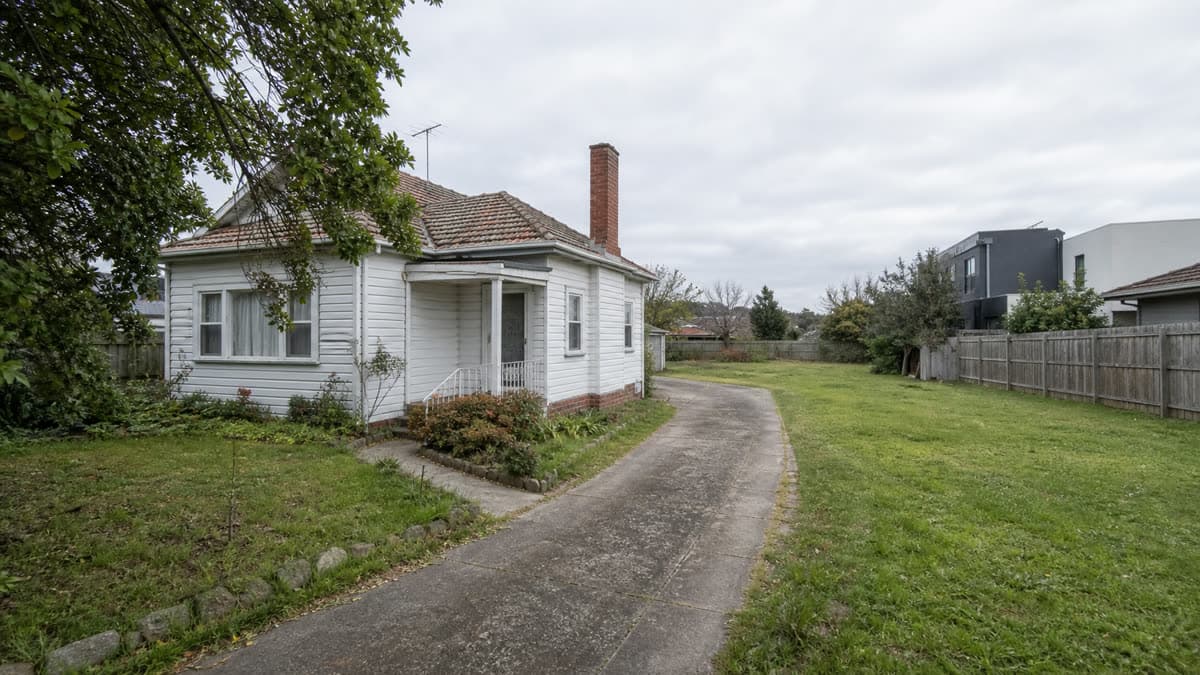
 Photo: SiteLogic editorial image
Valuation
Site value versus capital improved value in feasibility
Site value, capital improved value and net annual value measure different things and feed different lines of a feasibility. Confusing them produces the wrong number for land tax, rates or acquisition budgeting.
Every Victorian rates notice carries three valuation figures, and most developers read past two of them without knowing what they mean. Site value, capital improved value and net annual value are produced by the same statutory process but answer three different questions. Feed the wrong one into the wrong line of a feasibility and the error does not announce itself. It just sits there, quietly wrong, until settlement or an assessment notice corrects it for you.
This is not an academic distinction. Site value is the figure the State Revenue Office uses to calculate land tax. Capital improved value is what your council uses to calculate rates, and what most agents quote when they talk about a property's "value". Net annual value sits behind both, as the rental-equivalent figure from which the other two are partly derived. A developer who treats CIV as a proxy for site value, or vice versa, will misprice a holding cost or misjudge an acquisition.
What each valuation actually measures
The Valuer-General Victoria produces all three figures under a single statutory valuation, governed by the Valuation of Land Act 1960. They are not three independent assessments. They are three outputs of one methodology, and the Act defines each one precisely.
Site value is the value of the land alone, on the assumption that any improvements on it (the house, the shed, the driveway, the landscaping) do not exist. It answers the question: what would this land be worth if it were vacant. That is exactly the question a developer needs answered when assessing a site for redevelopment, because the existing dwelling is usually a demolition cost, not an asset.
Capital improved value is the value of the land and everything on it, as a going concern. It is the closest of the three to a conventional market value, and it is the figure most people mean when they say "the property is worth". For a site earmarked for redevelopment, CIV is a distorted number: it prices the improvements you are about to demolish alongside the land you actually want.
Net annual value is the annual rental value the land and improvements could reasonably be expected to produce, subject to a statutory minimum set as a percentage of capital improved value for non-rateable-purpose land. It underpins some categories of rating and, for commercial and industrial land, connects directly to how rates are struck. For most residential redevelopment sites you will see it, but it plays a smaller role in your feasibility than the other two figures.
The Valuer-General Victoria publishes the methodology and the general revaluation cycle that produces these figures for every rateable property in the state. The three figures move together but not proportionally: a site with a modest, ageing dwelling on a large block will show a CIV close to its site value, because the improvements contribute little. A site with a near-new architect-built home on a small block can show a CIV well above site value, because the improvements carry most of the number.
Where each figure belongs in a feasibility
Site value belongs in your land tax line. Land tax in Victoria is assessed against the site value of landholdings above the tax-free threshold, aggregated across a taxpayer's holdings in some circumstances. If you are holding a site through a feasibility period (design, permit, pre-sale), land tax accrues on site value for every year you hold it, and that holding cost needs to be modelled against the actual instrument, not against a market appraisal or a purchase price. Confirm the current threshold, rate scale and aggregation rules directly on the State Revenue Office's land tax pages before you model a number, because they are adjusted periodically and a stale figure understates a multi-year hold.
Capital improved value belongs in your council rates line, and nowhere else in a feasibility. It is not a proxy for what the land is worth to you as a developer, and it should never be used to sense-check an acquisition price. A common error is treating a low CIV as evidence a site is underpriced. It may simply mean the existing improvements are old and contribute little to the total; the site value component, which is what you are actually paying for, could still be fully priced.
Net annual value rarely needs its own line for a straightforward residential development feasibility, but it matters if the site carries a non-residential rating category, or if you are assessing a mixed-use scheme where part of the land generates rental income during a holding period before construction starts.
How to model it
The following figures are illustrative. They demonstrate the method and will vary by site, council and timing. Take a hypothetical corner allotment in a middle-ring municipality, notionally valued with a site value of $900,000 and a capital improved value of $1,050,000, reflecting a modest 1970s dwelling contributing around $150,000 to the CIV figure. A developer using CIV as their acquisition anchor would benchmark the purchase against $1,050,000 and potentially overpay, because the demolition cost of the existing dwelling, notionally $35,000 in this illustrative scenario, needs to come off that figure, not be added to it. The land tax line, meanwhile, should be modelled against the $900,000 site value across the projected hold period, escalated by the expected pattern of the annual valuation cycle, not against the higher CIV number. Getting this reversed in either direction moves the feasibility's bottom line in the wrong direction on two separate lines at once.
What to check before exchange
Pull the current valuation notice, or request a copy from the vendor, and identify all three figures individually rather than relying on an agent's verbal "it's valued at". Confirm which figure is being quoted when anyone in the transaction refers to "the valuation". It is frequently CIV, presented without qualification, because that is the figure ordinary residential buyers care about.
Check the site value trend across the last two or three general valuations, available through the council rates notice history or via a request to the Valuer-General Victoria. A site value that has jumped sharply between cycles signals either a genuine market shift in the area or a reassessment following nearby redevelopment activity, and either way it affects your land tax modelling for the hold period ahead.
Confirm whether the site sits in a municipality on the general valuation cycle that applies statewide, and note the date of the most recent valuation relative to your settlement date, since a valuation several months old may already lag a moving market in either direction.
Interaction with land tax aggregation
If the acquiring entity, or its associated entities, hold other Victorian land, the site value of this new acquisition may be aggregated with existing holdings for land tax purposes rather than assessed in isolation. This materially changes the marginal rate applied and is a common blind spot for developers running a portfolio of small sites through related entities. Confirm the current aggregation and grouping provisions on the State Revenue Office's site before finalising the acquisition structure, because the entity that holds title has a direct bearing on the land tax line of the feasibility, independent of the site value figure itself.
Published by the SiteLogic Editorial desk. Every fact traces to a primary source. See our standards and corrections register.
Fact-checked: 19 July 2026 · Review by: 19 July 2027
Sources: legislation.vic.gov.au · land.vic.gov.au
Was this useful? Try the tool this post is based on:
Pro on SiteLogic. Logi: up to 60 messages a day. Logi also stops at US$15 of model cost in a Melbourne calendar month. The Developer Comms Kit and unlimited saved projects. The Strategy Lab simulator runs without Pro. Saving a scenario needs a signed-in account. $60/month or $600/year, ex GST. First 3 months are $30/month, ex GST, on monthly Pro.