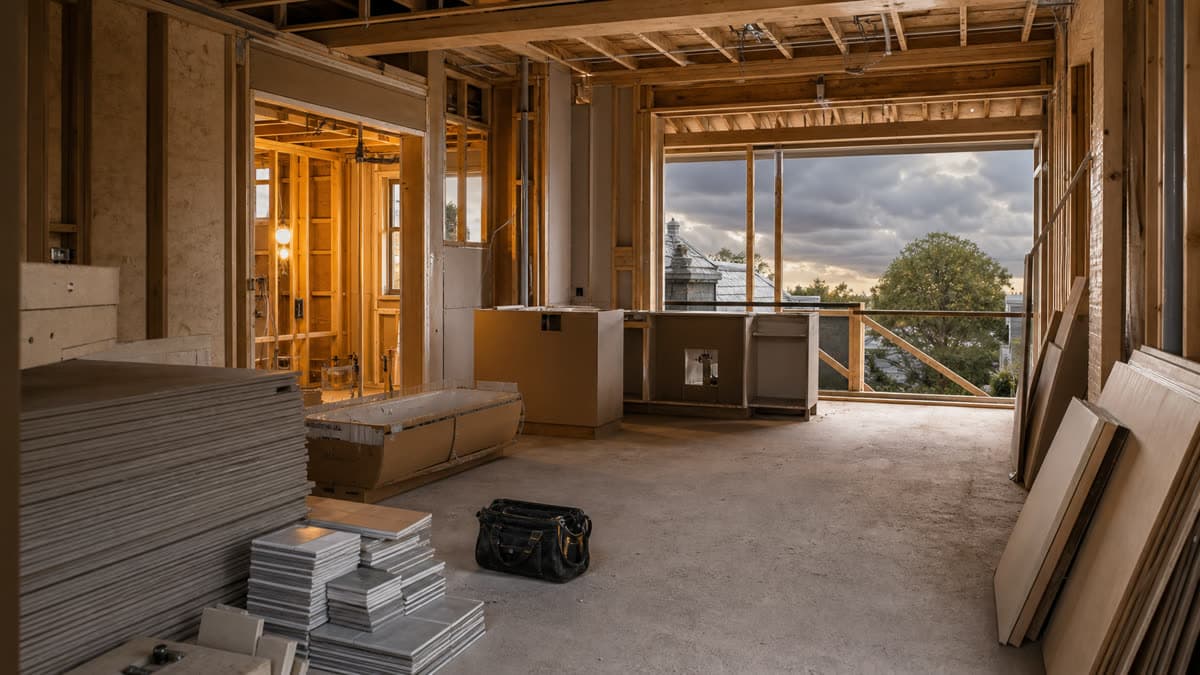
 Photo: SiteLogic editorial image
Construction Costs
Provisional sums and prime cost items: where budgets blow out
How provisional sums and prime cost allowances in a Victorian domestic building contract shift cost risk to the developer, and how to price and check them before signing.
The gap between a locked contract price and the actual cost of finishing a job usually opens up in two line items: provisional sums and prime cost items. Both let a builder price a domestic building contract without final information on every component, and both are legitimate contracting tools. They are also the most common place a townhouse or small apartment budget quietly moves after signing, because an allowance is, by definition, an estimate rather than a locked price.
What applies
A prime cost item, usually shortened to a PC item, is an allowance for a supply-only cost where the final selection has not been made when the contract is signed, commonly fixtures like tapware, tiles, or appliances. A provisional sum, or PS item, covers work where the scope or cost cannot be fully known at signing, commonly site conditions like excavation in rock, or specialist trade work that depends on what is found once the site is opened up.
Both mechanisms exist because a builder cannot honestly price what has not been decided or discovered yet. The Domestic Building Contracts Act 1995 sets the framework for how major domestic building contracts, the category most PS and PC items appear in, must handle cost items and variations, including how allowances are to be described in the contract and how the final adjustment against the allowance is meant to be calculated once the actual item or work is known. The specific disclosure and calculation requirements sit in the Act and in Consumer Affairs Victoria's published guidance, and they are the first place to check before relying on a contract's PS or PC clauses, because drafting quality varies a great deal between builders and standard-form contracts.
The commercial risk is structural rather than accidental. An allowance quoted low against what the market will actually deliver is not automatically improper, it may simply be an estimate that has not been tested against real supplier quotes. But the contract adjustment mechanism means that gap, however it arose, usually becomes a variation the developer pays, not a cost the builder absorbs. That asymmetry is why a developer reviewing a tender should read every PS and PC line as a question rather than a number: what was this allowance based on, and who carries the difference if it turns out to be wrong.
How to model it
The following figures are illustrative. They demonstrate the method and will vary by site, council and timing. Say a project carries a PC allowance of $15,000 for kitchen joinery and fixtures across a run of townhouses, and a PS allowance of $20,000 for excavation, based on a standard assumption about site conditions. If the actual kitchen selection made by the purchaser or the developer's own specification runs to $19,000, the $4,000 gap becomes a variation. If excavation strikes rock or services not shown on the original survey and the real cost comes in at $34,000, the $14,000 gap becomes another variation. Neither increase is unusual on its own. The risk is in how many PS and PC lines sit in a single contract and how tight the original allowances were set relative to what the finished product actually requires.
The modelling discipline that follows is straightforward. Treat every PS and PC line in a contract as a probable cost, not a locked cost, and build a contingency line specifically against those items rather than folding it into a single generic contingency for the whole build. Before signing, get the builder or quantity surveyor to show the basis of each allowance, ideally a real supplier or subcontractor quote rather than a round number, and compare that basis against the actual specification the project intends to deliver, not a generic spec the builder used to prepare the tender.
Where a project has many PS and PC lines because of a genuinely uncertain site, such as unknown subsurface conditions, or an unresolved specification, such as an unbuilt display product still being finalised, that is itself a signal to firm up decisions earlier rather than carry the uncertainty into construction, because the number of open allowances correlates with how much the final cost can move.
What to check before exchange
Before signing a building contract with material PS or PC content, ask for the calculation basis behind each allowance and check it against a current, project-specific quote rather than a builder's standing estimate from an earlier job. Ask how the contract's variation mechanism actually works when an allowance is exceeded or underspent, including whether the builder is entitled to margin on the difference, because contract drafting varies on this point and it changes who benefits from an underspend as much as who pays for an overspend.
Check the contract's disclosure of PS and PC items against the requirements described in the Domestic Building Contracts Act 1995 and the current guidance on Consumer Affairs Victoria's building and renovating pages, because the disclosure standard exists specifically to stop allowances being used as a way to present an artificially low headline contract price.
Finally, quantify total PS and PC exposure as a share of contract value before exchange, not after. A handful of PC allowances for finishes on an otherwise well-specified contract is a manageable and normal feature of domestic building work. A contract carrying many open allowances across structure, services and finishes is carrying a meaningfully larger range of possible final cost, and that range belongs in the feasibility model as a named risk, not folded silently into a single contingency line.
Practical steps
Where possible, convert PS and PC items into fixed-price scope before signing, even if that means a short delay while a specification is finalised or a geotechnical report is obtained. Every allowance converted to a firm price before contract removes one source of post-signing cost movement. Where an allowance cannot be avoided, document the basis in writing, keep the supporting quote on file, and revisit the number against actual market quotes at the point the selection or the site condition becomes known, rather than waiting for a variation claim to arrive as a surprise.
Set a governance rule at project level rather than leaving it to individual contract negotiations: a maximum acceptable share of contract value carried as PS and PC allowances, reviewed by whoever signs off the feasibility, not just the person negotiating the building contract. Consistency across a pipeline of projects makes the exposure visible at portfolio level, not just site by site.
Published by the SiteLogic Editorial desk. Every fact traces to a primary source. See our standards and corrections register.
Fact-checked: 19 July 2026 · Review by: 19 July 2027
Sources: legislation.vic.gov.au · consumer.vic.gov.au
Was this useful? Try the tool this post is based on:
Pro on SiteLogic. Logi: up to 60 messages a day. Logi also stops at US$15 of model cost in a Melbourne calendar month. The Developer Comms Kit and unlimited saved projects. The Strategy Lab simulator runs without Pro. Saving a scenario needs a signed-in account. $60/month or $600/year, ex GST. First 3 months are $30/month, ex GST, on monthly Pro.