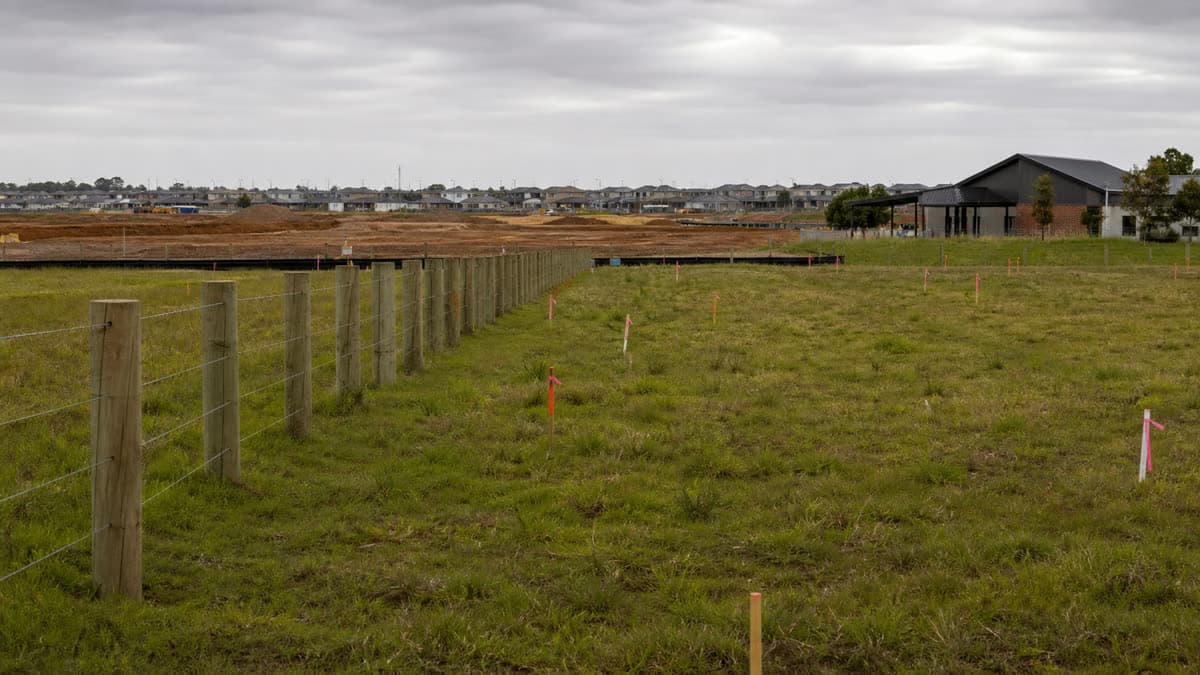
 Photo: SiteLogic editorial image
Holding Costs
Land banking economics and holding cost in Victoria
Why holding undeveloped land in Victoria costs more than it once did now that land tax and vacant residential land tax settings have tightened, and how to model the breakeven before committing capital to a land bank.
Land banking, the practice of acquiring a site well ahead of an intended construction start and holding it as inventory rather than developing it immediately, has always carried a holding cost. What has changed in Victoria is the size of that cost and how quickly it can escalate for land that sits idle rather than actively pre-developed. Land tax settings have moved more than once in recent years and vacant residential land tax has expanded its reach, which means a land banking strategy that pencilled out a few years ago needs re-testing against the current settings before a developer commits capital to sitting on a site.
Why developers land bank
There are legitimate reasons to hold a site rather than build straight away. A developer might secure a well-located parcel before a rezoning is finalised, assemble two or three adjoining lots before starting design, or wait out a soft sales market rather than launch into it. In each case the logic is the same: the expected uplift in land value, approved yield, or sale conditions over the holding period is expected to exceed the cost of holding the site idle. That is a reasonable strategy in principle. It is only a sound one if the holding cost side of the equation is modelled honestly rather than assumed away.
The economics of holding versus building
Every dollar tied up in land that is not generating income is also not earning a return elsewhere, and that opportunity cost sits alongside the direct carrying costs of interest, tax and rates. A developer holding land as inventory is effectively betting that the site's value, or the yield achievable on it, will rise faster than the combined cost of capital and statutory charges over the holding period. Because the direct carrying costs are now higher than they were, thanks to tightened land tax and vacant residential land tax settings, the bar for that bet to clear has moved up. A holding period that produced an acceptable return several years ago may not clear the same bar today.
Land tax and the holding calculation
Victorian land tax is assessed annually against the aggregate taxable value of a landholder's Victorian land above a threshold, and the applicable rate scale increases as the aggregate landholding value increases. A developer or related entity land banking several sites at once faces a materially different land tax position than a single-site holder, because the assessment aggregates across the whole portfolio. The current threshold, rate scale and any surcharge relevant to the specific ownership structure should be confirmed on the SRO land tax page before it is built into a land banking feasibility, and reconfirmed each year the site remains unbuilt, because a rate carried forward from the year of acquisition will understate the true cost on a multi-year hold.
Vacant residential land tax and the tightened settings
Vacant residential land tax sits alongside ordinary land tax and applies where land meets the relevant vacancy definition for the assessment period, a mechanism that has been broadened in scope more than once and now extends well beyond the areas where it first applied. This matters specifically for land banking because undeveloped residential land, or land with an existing dwelling left unoccupied while a design or permit is prepared, can trigger the tax in addition to ordinary land tax, materially changing the annual carry. Exemptions exist for land under genuine and continuous construction or renovation and for several other recognised categories, but a developer relying on an exemption should confirm the current criteria on the SRO vacant residential land tax page rather than assume a site qualifies, because the exemption tests are specific about the nature and continuity of works.
Modelling the breakeven
A defensible land banking feasibility starts with an honest holding period, then stacks every carrying cost against it: finance interest on the acquisition, ordinary land tax, vacant residential land tax if the site does not qualify for an exemption, council rates, and insurance and site security. That total carry is then compared against the expected uplift in achievable land value or yield over the same period, discounted for the risk that the uplift does not materialise on schedule, whether because a rezoning stalls, a market softens, or a permit process runs longer than planned. If the expected uplift does not clearly exceed the carry cost plus a margin for that risk, the land banking strategy is not paying for itself, however attractive the underlying site looks on inspection.
A worked example
The following figures are illustrative. They demonstrate the method and will vary by site, council and timing. Assume a $2 million site held for two years ahead of an anticipated rezoning, funded by debt at a rate that produces illustrative annual interest of $110,000. Illustrative ordinary land tax across the two assessment years adds $56,000. The site does not qualify for a construction exemption, so illustrative vacant residential land tax adds a further $60,000 over the period. Illustrative rates and insurance add $10,000. The illustrative total carry over the two years comes to $236,000. For the land bank to clear that cost plus a reasonable margin for the risk that the rezoning is delayed, the site's value would need to rise by well over $118,000 a year on this illustrative scenario, a bar that a straightforward extrapolation of recent comparable sales does not automatically clear.
Reducing exposure while holding
A developer who wants the option value of an early acquisition without the full carrying cost has alternatives to an outright purchase. An option agreement or a call option over the land defers the bulk of the purchase price and the associated land tax exposure until the option is exercised, at the cost of an option fee and less certainty of control. Getting a permit application into the system early, even ahead of a firm construction date, can also support a construction-related exemption from vacant residential land tax where the works genuinely commence, though this depends on meeting the specific exemption criteria rather than merely lodging an application. Staged acquisition of an assembled site, buying the first lot and settling later lots as design and finance progress, is another way to spread both the capital outlay and the tax exposure across the program instead of carrying the full holding cost from day one.
Before committing capital
Confirm the current land tax threshold and rate scale, and the current vacant residential land tax scope and exemption criteria, on the SRO pages before building a land banking feasibility, not once at acquisition and then never again. Model the holding period honestly, including the realistic prospect of delay, and compare the full carrying cost against an uplift assumption that is tested rather than hoped for. Where the numbers are marginal, consider an option or a staged structure that preserves the strategic benefit of an early move without carrying the full holding cost of an outright purchase.
Published by the SiteLogic Editorial desk. Every fact traces to a primary source. See our standards and corrections register.
Fact-checked: 19 July 2026 · Review by: 19 July 2027
Sources: sro.vic.gov.au · sro.vic.gov.au
Was this useful? Try the tool this post is based on:
Pro on SiteLogic. Logi: up to 60 messages a day. Logi also stops at US$15 of model cost in a Melbourne calendar month. The Developer Comms Kit and unlimited saved projects. The Strategy Lab simulator runs without Pro. Saving a scenario needs a signed-in account. $60/month or $600/year, ex GST. First 3 months are $30/month, ex GST, on monthly Pro.