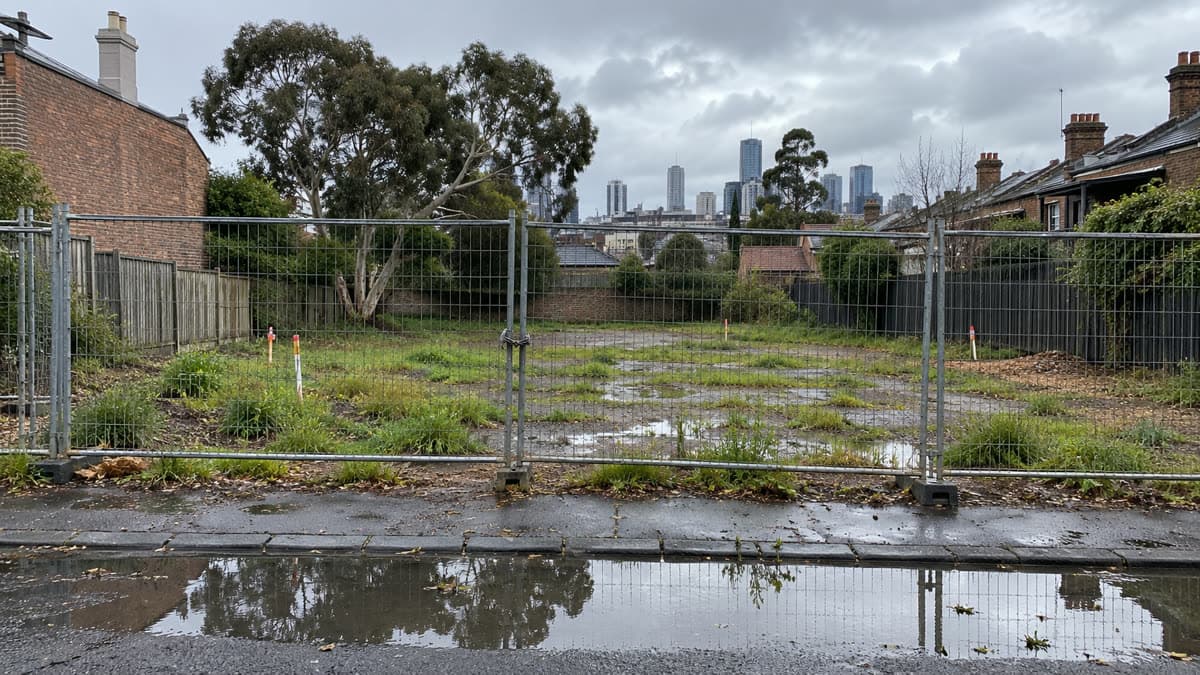
 Photo: SiteLogic editorial image
Land Tax
Holding a vacant site: Victorian land tax plus interest per month
A vacant Victorian site costs money every month it is held. A worked example adds land tax and loan interest at the current rate, shows the trust and absentee surcharge positions, and explains where vacant residential land tax could apply.
A vacant site earns nothing. It still costs money every month. The two charges that recur are interest on the money borrowed to buy it and Victorian land tax. The cash rate target rose to 4.60% on 30 September 2026, per the RBA's decision table, so the interest half of the sum has just moved.
This article adds the two together on a worked example, shows how the trust and absentee positions change the tax, and explains where vacant residential land tax could also be relevant. For the legal detail of the exemptions, see the earlier piece on vacant residential land tax exemptions.
How land tax is set
The State Revenue Office describes land tax as an annual tax on the total value of taxable land owned in Victoria, excluding exempt properties such as your home. It applies to investment residential properties, commercial properties and vacant land.
The SRO's current rates page says tax is calculated on the site values, set by the Valuer-General Victoria, of all taxable land you owned at midnight on 31 December of the year before the year of assessment. Land tax applies for a calendar year. The rates on that page apply to the 2024 to 2033 land tax years. The page publishes a general rate scale, a trust surcharge scale and scales that add the absentee owner surcharge. Check the page for the current tables before you rely on the figures below.
The worked example
The following figures are illustrative. They demonstrate the method and will vary by site, council and timing.
Assume a site with a site value of $2,400,000, which is the only taxable land the owner holds, and that the purchase price is also $2,400,000. The buyer borrows 70% of the price, which is $1,680,000, at 8.10%. That rate is an assumption: SiteLogic's feasibility default of the cash rate plus 3.5 points. Your lender's rate will differ.
General rates. For total taxable value from $1,800,000 up to $3,000,000, the SRO table gives $11,850 plus 1.65% of the amount above $1,800,000. The amount above is $600,000, so the tax is $11,850 + 0.0165 × $600,000 = $11,850 + $9,900 = $21,750 a year, or $1,812.50 a month.
Trust rates. For a trust, the same band reads $18,363 plus 1.1072% of the amount above $1,800,000. That is $18,363 + 0.011072 × $600,000 = $18,363 + $6,643 = $25,006 a year, or $2,084 a month. If the site is held in a trust, check the trust table against your structure.
Absentee owner surcharge. On the general scale with the surcharge, the SRO shows $83,850 plus 5.65% of the amount above $1,800,000. That is $83,850 + $33,900 = $117,750 a year, or $9,813 a month. Whether the surcharge applies depends on the owner's status, which the SRO's pages set out.
Interest. $1,680,000 × 0.081 ÷ 12 = $11,340 a month.
| Monthly cost | General rates | Trust rates | |---|---|---| | Interest at 8.10% | $11,340 | $11,340 | | Land tax | $1,813 | $2,084 | | Total | $13,153 | $13,424 | | Per year | $157,830 | $161,086 |
Interest is 86% of the general-rate total and 84% of the trust-rate total. So the rate matters more than the tax, and each rise moves the larger figure.
What the rise adds
At 7.85% the monthly interest is $1,680,000 × 0.0785 ÷ 12 = $10,990. The 25 point rise therefore adds $350 a month, or $4,200 a year. That equals 19% of the monthly land tax at general rates. All four rises this year, at 100 points, add $1,400 a month on the same loan.
A site held for 12 months before works start carries $157,830 to $161,086 at these inputs. A site held for 24 months while approvals run carries twice that. These sums come before holding insurance, council rates, security and maintenance.
Vacant residential land tax
A separate tax can apply to residential land that sits vacant. The SRO's vacant residential land tax page says it applies to Victorian residential land that was vacant in the previous year, and that it may apply to existing and uninhabitable homes, homes under construction or renovation and undeveloped land. The SRO's current rates page for vacant residential land tax says the tax is based on the land's capital improved value, not its site value. The rate depends on how long the land has been liable and on other circumstances. It is 1% of capital improved value for metropolitan Melbourne land that has remained undeveloped for five years or more and is capable of residential development, and for new residential land unused, unoccupied and unsold for more than three years. For other land, the rate is 1% in the first year of liability, 2% in the second and 3% from the third. The SRO notes that before 2025 the rate was 1% for all properties.
For a bare site, the relevant category is the first: metropolitan Melbourne land left undeveloped for five years or more. On the SRO's table that category is taxed at 1%, not the rising scale. The 2% and 3% rates are for other vacant residential land.
Assume a capital improved value of $2,600,000. At 1% the tax is $26,000, or $2,167 a month. For other vacant residential land, the same value would be taxed at $52,000 at 2% and $78,000 at 3%. Exemptions exist for land under renovation or construction, and the earlier article covers them. The point for a model is that the vacant residential land tax line, if it applies, can be larger than the ordinary land tax line in the years it applies: $26,000 against $21,750 on these inputs. Whether the land is liable, and how the tax sits alongside ordinary land tax, is a question for the SRO's rules and your adviser.
The 31 December date
Because the assessment looks at who owned the land at midnight on 31 December of the preceding year, a settlement date either side of that line can change which year's bill arrives. Which party counts as the owner at that date turns on the contract and the Land Tax Act 2005, and the SRO's pages set out the detail. Check the position with your adviser and the SRO before fixing a settlement date, because the saving or the cost is a full year of land tax.
What to check
- The site value. Find the Valuer-General's site value for the lot and use it, not the purchase price.
- The entity. Confirm whether the owner is an individual, a company or a trust, and which scale applies. Check whether the absentee owner surcharge applies.
- The vacant residential land tax position. Find out whether the land is liable and, if so, which exemption you plan to rely on and what evidence it needs.
- The settlement date. Compare the tax under settlement before and after 31 December.
- The monthly figure. Put interest and tax into the feasibility as a monthly holding cost and multiply by the months you expect to hold. Use the SRO's own land tax calculator to check the tax.
SiteLogic's public Vic development conditions panel shows the cash rate beside approvals, building costs and other signals. Check it for current readings.
This is general information and not financial advice.
Published by the SiteLogic Editorial desk. Every fact traces to a primary source. See our standards and corrections register.
Fact-checked: 3 October 2026 · Review by: 3 January 2027
Sources: sro.vic.gov.au · sro.vic.gov.au · sro.vic.gov.au · sro.vic.gov.au · rba.gov.au
Was this useful? Try the tool this post is based on:
Pro on SiteLogic. Logi: up to 60 messages a day. Logi also stops at US$15 of model cost in a Melbourne calendar month. The Developer Comms Kit and unlimited saved projects. The Strategy Lab simulator runs without Pro. Saving a scenario needs a signed-in account. $60/month or $600/year, ex GST. First 3 months are $30/month, ex GST, on monthly Pro.