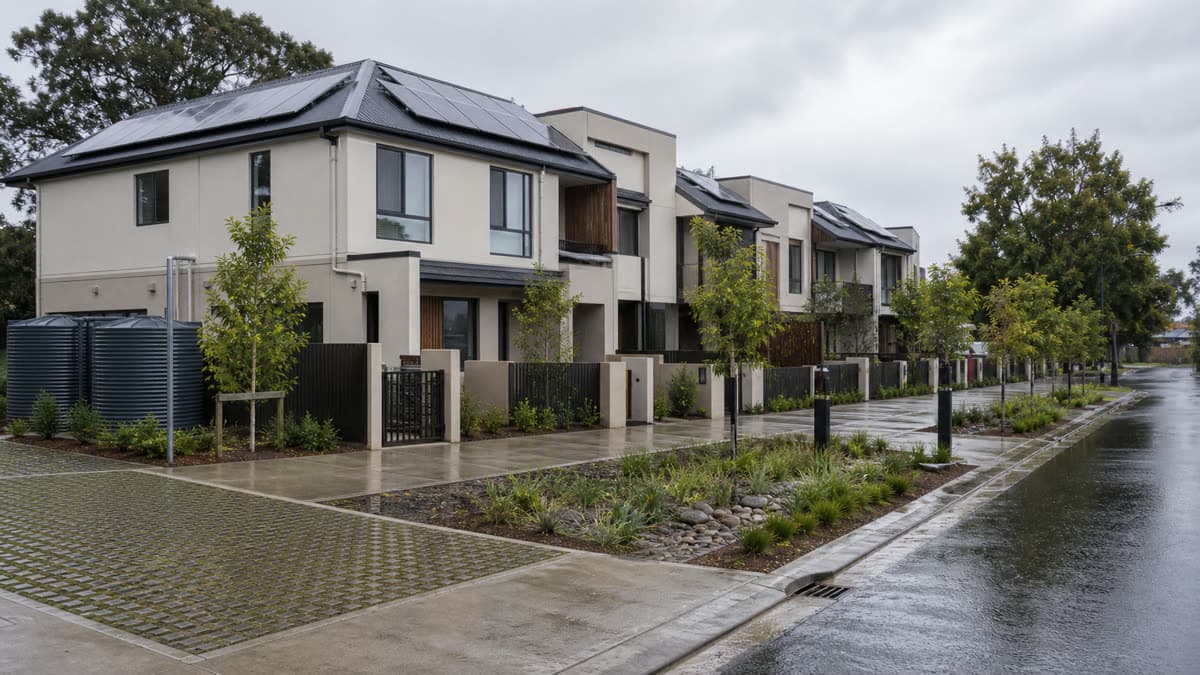
 Photo: SiteLogic editorial image
ESD
ESD and CASBE local policies: why council thresholds still change the permit path
Victoria's local ESD policies still sit in council planning schemes, but the practical variation is in when a project tips from annotated plans to an SDA or a full SMP. Here is what changes between councils, what it means for feasibility, and what to check before exchange.
Environmentally sustainable design is now a routine planning-permit issue in metropolitan Victoria, but developers still lose time by treating it as a generic box-tick. The state position is broad. Planning Victoria says local councils in Victoria have local environmentally sustainable development planning policies in their planning schemes, and it also says the ESD Roadmap changes do not directly alter those local policies.
That means the commercial question is no longer whether ESD exists. It is how the relevant council wants the issue documented, at what scale the documentation burden increases, and when a BESS printout stops being enough on its own. Those differences can affect consultant scope, permit timing and redesign risk before a planner reaches neighbourhood character, overlooking or traffic.
What changed
The important change is not a single new statewide threshold. It is the coexistence of state-level sustainable-development reforms with older local ESD pathways that still operate through council planning schemes and application guidance. Planning Victoria's ESD page is explicit on that point: local environmentally sustainable development policies remain in planning schemes, even while other state reforms continue around stormwater, gas connection settings and related sustainability issues.
For applicants, that leaves a live council-by-council layer sitting underneath the same Victorian planning system. In practice, the CASBE-aligned framework has made the categories familiar across many municipalities, but the trigger points are still local. One council may accept annotated plans for a small project and move to an SDA at three dwellings. Another may ask for an SDA at two dwellings. A third may draw a separate line for accommodation uses that are not ordinary dwellings.
That is why the variation matters in feasibility. The yield may be the same on paper, but the permit path can change once the project crosses a local ESD threshold that brings a separate report, another consultant and a more detailed response on energy, water, stormwater, waste and urban ecology.
What applies
Monash shows the basic structure clearly. Its ESD guidance says small residential developments of one to two dwellings can address sustainable design through plans and drawings. It then moves to a mandatory Sustainable Design Assessment for medium developments of three to nine new residential dwellings, or non-residential proposals between 500 square metres and 1000 square metres. At 10 or more new dwellings, or 1000 square metres and above for non-residential work, Monash requires a Sustainability Management Plan and says an ESD consultant must prepare that submission.
Stonnington uses the same broad SDA-to-SMP logic but with a different threshold for smaller non-residential projects. Its guidance says a project will likely be categorised as medium where it is a residential development of between two and nine dwellings, or a non-residential development between 100 square metres and 1000 square metres. It then treats large development as more than 10 dwellings or more than 1000 square metres, and says further information may be requested with the SDA or SMP, including BESS reports, water and stormwater material, appliance ratings and notated sustainability features on the plans.
Merri-bek is more specific again. Its page says an SDA is required for accommodation or mixed-use development of two to nine dwellings, for buildings for accommodation other than dwellings between 50 square metres and 1000 square metres, and for non-residential buildings between 100 square metres and 1000 square metres. It then requires an SMP for accommodation or mixed-use development of 10 or more dwellings and for larger accommodation and non-residential buildings above 1000 square metres. Merri-bek also says a BESS report alone will not satisfy the SMP requirement and that large developments require a post-construction report to satisfy permit requirements.
Bayside's SDAPP material reinforces the broader permit-path point. It says an SDA is required for medium developments of two to nine dwellings or 100 square metres to 1000 square metres of non-residential floor area, while an SMP is required for larger developments of 10 or more dwellings or more than 1000 square metres of non-residential floor area. It also states that preparing an SMP may require a sustainability professional.
The pattern is consistent enough to be recognisable and different enough to matter. CASBE has made the categories more legible. It has not made every municipal threshold interchangeable.
How to model it
For acquisition and early scheme testing, the safest approach is to price ESD in three separate bands.
The first band is the small-project band, where the council may accept sustainable-design measures shown directly on the plans and drawings. That does not mean the issue disappears. It means the cost is mainly in design discipline and coordination rather than a separate planning-stage report.
The second band is the SDA band. Once the project lands in that range, the practical task is no longer only to design responsibly. It is to assemble a planning document that records the commitments clearly enough for assessment and permit conditions. On a townhouse project, that may still be manageable without a separate consultant, but it takes time and a disciplined set of annotated drawings. The site plan, landscape layout, glazing notes, rainwater measures and stormwater response need to say the same thing.
The third band is the SMP band. This is where the permit path starts to carry clearer external cost and programme consequences. Monash says an ESD consultant must prepare the SMP submission. Merri-bek says a BESS report alone is not enough and large developments require more rigour plus a post-construction report. Bayside says preparing an SMP may require a sustainability professional. In feasibility terms, that means a named consultant allowance, more detailed design coordination and a greater chance of permit conditions that need to be discharged with follow-up evidence.
Mixed-use and accommodation projects need extra care because some councils split those categories differently from ordinary non-residential buildings. Merri-bek, for example, uses a 50 square metre to 1000 square metre band for buildings for accommodation other than dwellings, while its general non-residential threshold starts at 100 square metres. If the scheme only works because it sits just below a reporting threshold, the land note should say so plainly. That is not pessimism. It is good underwriting.
What to check before exchange
First, confirm the municipality's current ESD application guidance before treating the planning path as standard. The existence of a local ESD policy is not the useful insight. The useful insight is the trigger point for that council.
Second, test the project against the council's own residential, mixed-use and non-residential categories. A nine-dwelling townhouse concept and a 10-dwelling concept can carry the same zoning response and a different ESD document burden.
Third, identify whether the council expects only a BESS-backed SDA or a fuller SMP with consultant input. If the project is already near the large-project line, price that difference before the acquisition figure is settled.
Fourth, read the guidance for extra evidence beyond the headline threshold. Stonnington expressly notes that additional information may be requested with an SDA or SMP. Merri-bek requires more than a BESS report for an SMP and also wants post-construction reporting on large developments.
Finally, carry the ESD pathway as a named permit-risk item in the model. The cost is rarely catastrophic on its own. The problem is hidden friction: extra design time, another specialist, further requests for information and conditions that push the permit programme longer than the acquisition model assumed.
The practical takeaway is straightforward. Victoria's ESD framework is no longer novel, but it is not fully standardised at council level either. CASBE has helped create a common language. It has not removed the need to read the local trigger table before the site goes unconditional.
Published by the SiteLogic Editorial desk. Every fact traces to a primary source. See our standards and corrections register.
Fact-checked: 16 June 2026 · Review by: 16 June 2027
Sources: Planning Victoria - Environmentally sustainable development of buildings and subdivisions · City of Monash - Environmentally Sustainable Design · City of Stonnington - Sustainability in your planning application · Merri-bek City Council - Environmentally Sustainable Design · Bayside City Council - SDAPP Explained
Was this useful? Try the tool this post is based on:
Pro on SiteLogic. Logi: up to 60 messages a day. Logi also stops at US$15 of model cost in a Melbourne calendar month. The Developer Comms Kit and unlimited saved projects. The Strategy Lab simulator runs without Pro. Saving a scenario needs a signed-in account. $60/month or $600/year, ex GST. First 3 months are $30/month, ex GST, on monthly Pro.