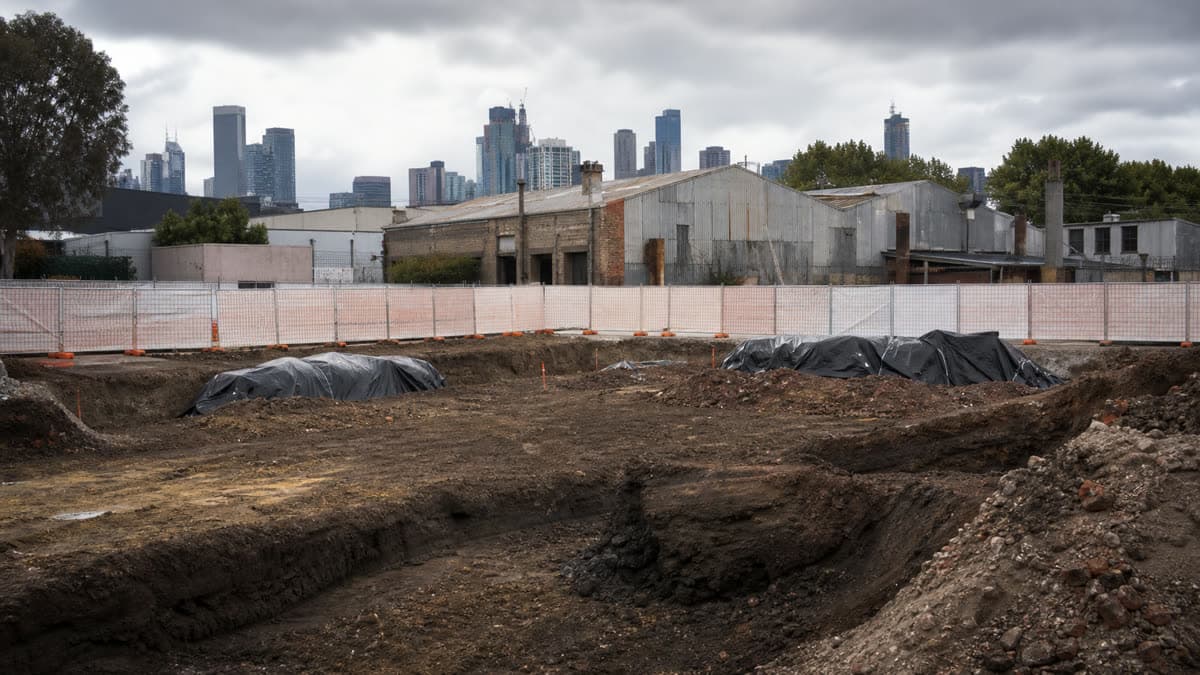
 Photo: SiteLogic editorial image
Environmental Audit Overlay
Environmental Audit Overlay: what the contaminated land gate means for Victorian feasibility
An Environmental Audit Overlay does not prove a site is contaminated. It does mean the planning system expects a formal contaminated-land assessment before a sensitive use can proceed. Here is how that gate affects timing, risk and land price discipline.
An Environmental Audit Overlay is one of the clearest signals that a site can carry a contamination issue into the planning process. It is not the same thing as a confirmed contamination finding. It is a legal gate. If the intended project moves land into a sensitive use, the site may need a preliminary risk screen assessment or a full environmental audit before that use can proceed. For a developer, that turns contamination from a background legal issue into a feasibility timing issue.
That matters because contaminated-land risk rarely stays small once it arrives late. If the first serious contamination question is raised after exchange, the project may be carrying holding costs while site history, limited sampling, auditor engagement and permit dependencies are sorted out. The EAO is a reminder that the sequence has to run before the land price is treated as settled.
What changed
EPA Victoria's land-use-planning guidance treats potentially contaminated land and land affected by an Environmental Audit Overlay as sites that may need formal assessment before planning decisions are made. The same guidance explains that the presence of an EAO means the land has been identified as potentially contaminated, but the contamination has not yet been assessed.
That distinction is commercially important. The overlay does not say the site is unusable. It says the planning system does not yet have enough evidence to allow a sensitive use or associated building works to proceed without another step.
EPA says planning and responsible authorities may require a preliminary risk screen assessment, or PRSA, or an environmental audit for sites with potentially contaminated land or an EAO. The outcome of that work can influence both planning applications and planning scheme amendments.
What applies
EPA's planning guidance says potentially contaminated land has a specific meaning under the land-use-planning framework. It includes land used or known to have been used for industry or mining, for the storage of chemicals, gas, waste or liquid fuel, or where a known past or present activity or event may have caused contamination.
The trigger is not every old commercial address. The practical question is whether the current or proposed use is one that could be significantly affected by contamination. EPA's explanation of Ministerial Direction 1 says the key category is sensitive use. That includes residential use, a childcare centre, a kindergarten, and a preschool centre or primary school. The direction also reaches children's playgrounds, secondary schools, and in some circumstances agriculture and public open space.
For land with an EAO, EPA says the site cannot be used for a sensitive use, or developed through building and works associated with a sensitive use, until one of the recognised pathways is satisfied. That can be a PRSA stating an environmental audit is not required for the use, or an environmental audit statement or certificate showing the land is suitable for the use or proposed use.
So the EAO question covers two things: "is there contamination" and "what is the proposed end use". The same former industrial site may have a different pathway if it remains in a commercial use than if it moves to apartments or townhouses.
How to model it
The first assessment step is usually the PRSA. EPA says a PRSA helps decide whether an environmental audit is required. It does not replace an environmental audit, and it does not itself confirm that the site is suitable for an existing or proposed use. Its job is narrower: review the site history, consider the likelihood of contaminated land, and recommend whether an audit is needed and, if so, how broad that audit should be.
EPA also says the preliminary site investigation behind a PRSA starts with the site's history and current land use. Limited and targeted sampling may be used to confirm that no contamination is present, but the PRSA is not meant to become a whole-site contamination program by stealth. That matters for feasibility because it means a PRSA can narrow the problem, but it cannot always close it.
The published PRSA outcomes are commercially useful. EPA says the auditor can conclude:
- contaminated land is unlikely and an environmental audit is not required
- contaminated land is likely, but an environmental audit is not required for the proposed use
- contaminated land is likely and an environmental audit is required.
If the site moves to the third outcome, the program changes materially. EPA says a simple environmental audit can take a few months to a year, while large or complex sites often take more than a year. The auditor must first define the scope, including the site identity, the environmental elements being assessed, the standards and reference documents being used, any exclusions, and the current or proposed site use where land-use suitability is the issue.
The audit outcome is not binary in the way many acquisition models assume. EPA says a suitability-of-land-use audit may conclude that the site is suitable, suitable if the audit recommendations are met, or not suitable for the specified use at the time of the statement. That middle category is the one feasibility models often miss. A site can move forward, but only with management measures, permit conditions, clean-up sequencing or ongoing controls that still affect cost and programme.
Cost treatment
The official guidance does not support a single standard allowance for an EAO site. EPA's own advice for choosing an environmental auditor is to obtain quotes, make sure the scope of work is clearly described, and deal upfront with how extra work and delays will be handled. That is a strong signal that the cost outcome depends on scope, site history and what the first round of assessment finds.
The better modelling approach is to split the allowance into stages rather than bury it inside generic contingency.
Start with the early assessment cost: historical review, possible limited targeted sampling, consultant input if used, and auditor sign-off for the PRSA. Then separate any later audit cost, because that only becomes real if the PRSA pushes the site into a full audit pathway. After that, carry a third bucket for any response required by the audit result, such as clean-up, capping, vapour controls, imported fill protocols, management statements or ongoing land-use conditions.
That staged structure matters more than pretending to know the final number on day one. The commercial risk on an EAO site is often not that the first report is expensive. It is that the first report moves the site into a slower and broader workstream that changes finance cost, settlement timing and the range of bankable end uses.
What to check before exchange
Run the contaminated-land screen before the contract becomes unconditional.
First, confirm whether the land already carries an EAO or whether the planning authority may treat it as potentially contaminated land under the planning framework. Former service stations, industrial lots, workshops, land with chemical or fuel storage, and some older utility or extraction sites should not be priced as clean by default.
Second, define the proposed use clearly. Residential redevelopment is the common pressure point because sensitive use is where the planning system expects stronger evidence.
Third, decide whether the due diligence budget is only for a history-based screen or for a PRSA pathway. EPA says a PRSA can take several weeks or months depending on the size and history of the site, so it is not a same-week checkbox on a complex parcel.
Fourth, if a PRSA or audit is required, treat the report outcome as a pricing event. A "suitable subject to recommendations" result is still usable, but those recommendations may reshape design, staging, finance and permit conditions.
Fifth, check whether the deal structure gives enough time to respond if the first assessment escalates. A contamination issue discovered early is a due diligence finding. The same issue discovered after exchange is usually a margin problem.
The feasibility consequence is straightforward. An EAO does not automatically kill a Victorian development site. It does remove the right to assume the site is clean enough for a sensitive use without proof. Where that proof has not yet been bought, timed and priced, the residual should stay with the model rather than being hidden in optimism.
Published by the SiteLogic Editorial desk. Every fact traces to a primary source. See our standards and corrections register.
Fact-checked: 10 June 2026 · Review by: 10 June 2027
Sources: EPA Victoria - Assessing potentially contaminated land for land use planning · EPA Victoria - Preliminary risk screen assessment · EPA Victoria - Environmental audits · EPA Victoria - Choose an environmental auditor · Environment Protection Act 2017 (Vic)
Was this useful? Try the tool this post is based on:
Pro on SiteLogic. Logi: up to 60 messages a day. Logi also stops at US$15 of model cost in a Melbourne calendar month. The Developer Comms Kit and unlimited saved projects. The Strategy Lab simulator runs without Pro. Saving a scenario needs a signed-in account. $60/month or $600/year, ex GST. First 3 months are $30/month, ex GST, on monthly Pro.