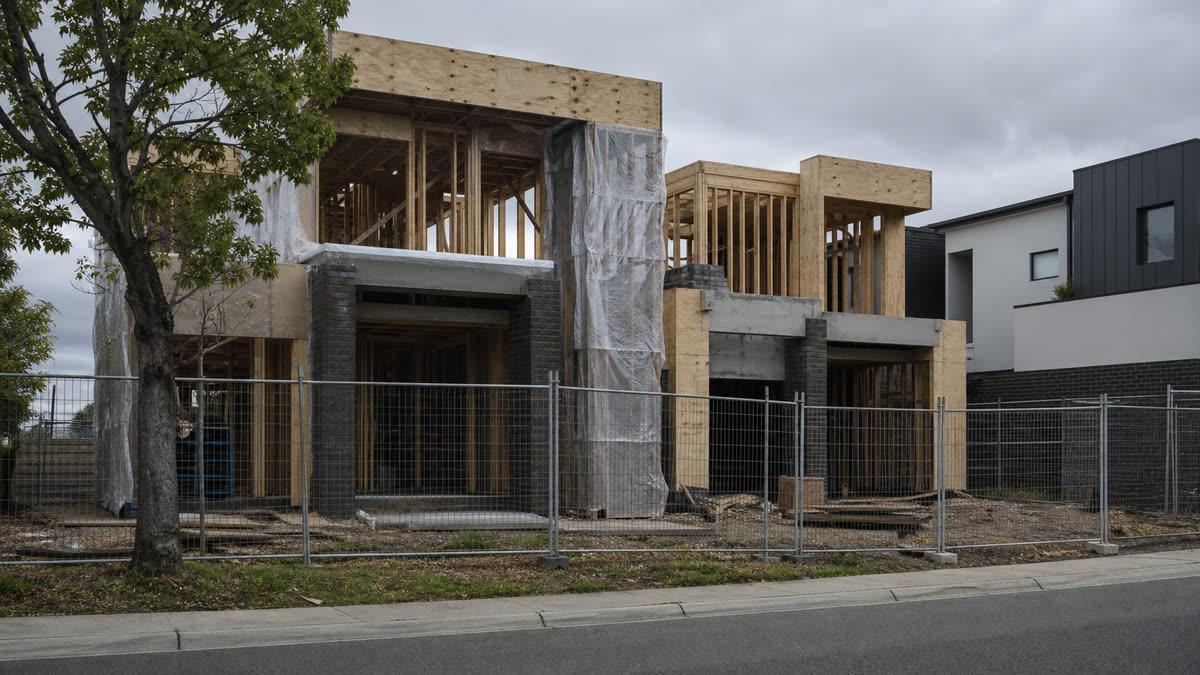
 Photo: SiteLogic editorial image
Builder Risk
Domestic building insurance: the trigger and its limits
When domestic building insurance responds in Victoria, what it covers, and the gaps a developer still carries once the builder's cover is in place.
Domestic building insurance is one of the more misunderstood protections in Victorian residential construction, partly because of its name. It is often described in the market as builder's warranty insurance, which suggests it protects the builder. It does not. It is cover the builder is required to obtain for the benefit of the owner, administered through VMIA as scheme manager, with the Victorian Building Authority regulating the builder registration and compliance side of the same framework under the Building Act 1993. For a developer relying on a builder to complete a townhouse project, understanding exactly when this cover responds, and when it does not, is part of ordinary risk management rather than a background compliance detail.
What applies
Domestic building insurance is required for domestic building work once the contract meets the threshold for cover set out in the current regulations, and that threshold, along with the categories of work it applies to, should always be checked directly against VMIA and VBA rather than assumed from an earlier project. The insurance is arranged and paid for by the builder, but the named beneficiary is the owner, which in a developer's case means the corporate or individual entity that holds the land and has contracted the builder.
The important distinction is what triggers a valid claim. Domestic building insurance responds to a defined set of circumstances: the builder's death, disappearance, insolvency, or the builder's registration being suspended or cancelled for failing to comply with a direction to rectify or complete defective or incomplete work. It does not respond simply because an owner or developer is unhappy with the pace, quality or cost of a project while the builder is still trading and able to perform. That distinction sits at the centre of how the cover should be modelled into project risk.
What it covers and its limits
Where a trigger event occurs, the cover generally responds to incomplete work and to defects in work that was performed, with claim periods that differ depending on whether the issue is structural or non-structural in nature. The exact periods and the maximum amount payable under a policy are set by the current scheme rules, and both should be confirmed at the VBA's domestic building insurance page before a developer relies on the cover as part of a risk assessment, since scheme settings can change and a figure carried over from an earlier project may no longer be current.
The cap on claim value matters commercially because it is not automatically the same as the cost to finish or rectify the building. On a straightforward single dwelling the gap may be modest. On a multi-unit project, or a project with a higher specification, the cost to complete after a builder failure, including remobilising a new contractor, redesign where necessary, and any demolition of non-compliant work, can exceed what a single policy pays. That gap is the developer's risk to carry, not the insurer's.
What it does not cover: the gaps a developer carries
The cover does not extend to ordinary contractual disputes over scope, quality or delay while the builder remains registered and able to complete the work. Those disagreements sit inside the building contract itself and are resolved through the contract's variation and dispute mechanisms, not through a domestic building insurance claim.
It also does not compensate for consequential loss. Holding costs on land and finance, the cost of carrying a construction facility for longer than planned, and any lost opportunity from a delayed settlement or sale are not covered by the policy responding to a builder's failure. Those costs fall entirely on the developer during the period between a trigger event and the completion of remedial work by a new contractor.
There is also a classification boundary worth understanding. The insurance regime applies to work that meets the definition of domestic building work, a classification that turns on the nature and scale of the building rather than simply on whether the finished product is residential. A project that grows in scale or configuration can shift outside that classification, which changes the position on cover entirely. Where a project sits close to that line, it is worth confirming the classification directly with the VBA rather than assuming residential use alone settles the question.
How to model it
Treat domestic building insurance as a floor under downside risk rather than a substitute for choosing a financially sound builder in the first place. In a project risk assessment, carry a separate allowance for the gap between the policy's claim cap and the realistic cost to complete or rectify the work, and a further allowance for holding costs during the period a replacement builder is sourced and remobilised, since the policy does not compensate for time lost.
The following figures are illustrative. They demonstrate the method and will vary by site, council and timing. Consider a townhouse project where the builder becomes insolvent midway through construction. If the cost to engage a new contractor to complete the remaining work, including remobilisation and making good some incomplete trades, comes in above what the policy pays, the developer carries that difference directly, on top of several months of additional holding costs while the transition takes place. Modelling that combined exposure as a standing contingency, rather than assuming the insurance covers the full cost of a builder failure, is the more realistic approach.
What to check before exchange
Confirm the builder's registration is current and that a valid domestic building insurance certificate is in place before work starts, or before the first drawdown under a construction facility, since lenders typically treat evidence of the policy as a condition of funding. Confirm the certificate names the correct builder entity and references a contract value consistent with the actual contract. Confirm the current claim cap and time limits directly against VMIA and VBA rather than a previous project's figures, and be clear on which events trigger the cover and which are ordinary contractual matters instead.
Record keeping and review
Keep the domestic building insurance certificate with the contract file for the life of the project, and check whether a material variation that increases the contract value requires the policy to be updated. If the builder's registration status changes during construction, revisit the position immediately rather than assuming existing cover remains adequate. The insurance is a genuine protection, but it is a backstop with defined triggers and defined limits, not a general guarantee that a project will be completed.
Published by the SiteLogic Editorial desk. Every fact traces to a primary source. See our standards and corrections register.
Fact-checked: 19 July 2026 · Review by: 19 July 2027
Sources: vba.vic.gov.au · legislation.vic.gov.au
Was this useful? Try the tool this post is based on:
Pro on SiteLogic. Logi: up to 60 messages a day. Logi also stops at US$15 of model cost in a Melbourne calendar month. The Developer Comms Kit and unlimited saved projects. The Strategy Lab simulator runs without Pro. Saving a scenario needs a signed-in account. $60/month or $600/year, ex GST. First 3 months are $30/month, ex GST, on monthly Pro.