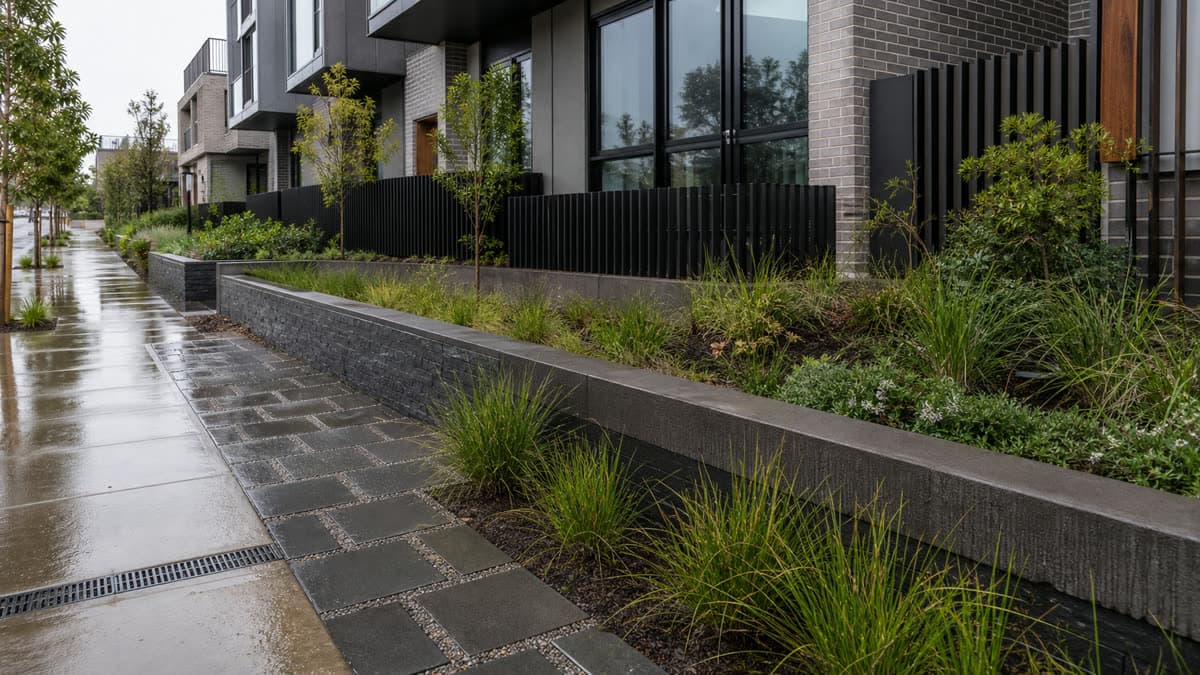
 Photo: SiteLogic editorial image
planning
Clause 53.18: stormwater management in urban development
How VPP Clause 53.18 requires water sensitive urban design in residential development, and how to model the cost of meeting best-practice stormwater objectives.
What applies
Clause 53.18 is the state-wide provision that brings stormwater management, and water sensitive urban design (WSUD) with it, into the permit process for residential development. Its purpose is set out plainly in the clause: minimise damage to properties and inconvenience to residents from stormwater, promote the retention and reuse of stormwater, reduce peak stormwater discharge, protect the environmental values and physical characteristics of receiving waters, and encourage stormwater management that maximises the quality of run-off leaving a site. Those objectives, not a single number, are the operative test.
The clause's application provisions set out which categories of development it captures, typically including construction of two or more dwellings on a lot and residential subdivision, together with any exemptions and schedule variations. Because application triggers and exemptions are the sort of detail that shifts between amendments, confirm the current wording of the application and exemption provisions against the clause itself before assuming a project sits inside or outside its reach. A planner who works from a remembered version of the clause, rather than the current ordinance, is the most common source of an avoidable permit condition later.
What applies to the design response
Where the clause applies, the applicant must demonstrate that the stormwater management system for the site has been designed to meet the current best practice environmental management objectives for stormwater, referenced in the clause and supported by guidance such as Melbourne Water's planning and building material on WSUD. In practice this means a stormwater management plan, or equivalent supporting document, showing how the design achieves retention, treatment and discharge outcomes for the site, rather than simply piping run-off to the street.
The decision guidelines direct the responsible authority to consider the practicality of achieving the best-practice objectives having regard to the site's soil type, slope, existing drainage infrastructure and any relevant floodplain or catchment strategy. A steep, poorly draining, or highly constrained site may not be able to meet every objective through on-site measures alone, and the clause anticipates that the assessment is a balancing exercise rather than a fixed checklist.
How to model it
Fold the stormwater response into the site cost plan at concept stage, not after the permit is drawn. A WSUD system, whether it is a rain garden, a bioretention basin, an underground detention tank, permeable paving, or a combination, has a capital cost, an ongoing maintenance cost, and a footprint that competes with saleable or leasable area. Underestimating any of the three is a common feasibility error on medium-density sites where every square metre of common area already carries a cost.
The following figures are illustrative. They demonstrate the method and will vary by site, council and timing. A townhouse project on a 900 square metre lot might allow a nominal $25,000 for a combined rain garden and detention system, plus $1,500 a year in an owners corporation budget for inspection and sediment removal, and a 15 square metre footprint taken from the rear common area. None of those numbers should be treated as a benchmark. The discipline is to price the WSUD response as a distinct line item, size it against the site's actual catchment area, and test what happens to the yield if the footprint required turns out to be larger than assumed.
Engage a civil or stormwater engineer early enough that the WSUD footprint is locked in before the architectural layout is finalised. A system added late, once unit layouts are set, tends to be more expensive and less effective than one designed into the site plan from the outset.
What to check before exchange
Ask the vendor or their agent whether a stormwater management plan has already been prepared or approved for the site, and if so, obtain a copy. An existing plan tells you what the previous owner or a prior permit applicant assumed about the site's constraints, which can save engineering fees or flag a problem early.
Check whether any existing permit condition or approved plan of subdivision imposes an ongoing maintenance obligation, such as an owners corporation responsibility for a shared detention asset, and whether that obligation is documented anywhere a buyer would actually see it. Confirm with the responsible authority, or with Melbourne Water where it is the relevant drainage authority for the catchment, whether there are known downstream capacity constraints that could affect the discharge rate a design is permitted to achieve. A site that looks straightforward on the zone map can still sit in a catchment where council or Melbourne Water is unwilling to accept additional peak flow without significant on-site attenuation.
Interaction with other controls
Clause 53.18 rarely operates alone. Sites affected by a Land Subject to Inundation Overlay, a Special Building Overlay or a Floodway Overlay carry additional referral and design requirements that interact directly with the stormwater response, and the combined effect of an overlay plus Clause 53.18 can be more restrictive than either read in isolation. Subdivision proposals should also be checked against Clause 56, which carries its own integrated water management expectations for new lots.
Where a site sits within a declared special area or a council has adopted a local stormwater or integrated water management strategy, that strategy may inform how the responsible authority interprets the decision guidelines, even though it is not itself the statutory instrument. Ask the council's engineering or drainage department directly whether such a strategy exists and applies to the site.
Practical steps for applicants
Bring a civil engineer with WSUD experience into the design team before the first concept plan is fixed, not after council raises a request for further information. A stormwater management plan prepared alongside the architectural response is cheaper to revise, and less likely to force a late change to unit layout or common area, than one bolted on to satisfy a condition.
Where the project includes a body corporate or owners corporation, draft the maintenance schedule for any shared WSUD asset at the same time as the plan of subdivision, so the obligation is visible to a purchaser's solicitor from the outset rather than surfacing as a surprise at settlement.
Record keeping and review
Once a permit issues, keep the approved stormwater management plan, the engineering computations behind it, and any maintenance schedule in the project file alongside the permit document itself. These records matter well beyond settlement: a future owners corporation, a subsequent purchaser, or a council compliance audit may all need to see how the system was designed to perform and what maintenance it assumes.
Because best practice guidance and local strategies are periodically updated, revisit the current version of Clause 53.18 and any referenced guidelines before relying on a design developed for an earlier project. A stormwater response that satisfied the objectives on a previous site is a starting point for the next one, not a substitute for checking the clause as it currently stands.
Published by the SiteLogic Editorial desk. Every fact traces to a primary source. See our standards and corrections register.
Fact-checked: 19 July 2026 · Review by: 19 July 2027
Sources: planning-schemes.app.planning.vic.gov.au · melbournewater.com.au
Was this useful? Try the tool this post is based on:
Pro on SiteLogic. Logi: up to 60 messages a day. Logi also stops at US$15 of model cost in a Melbourne calendar month. The Developer Comms Kit and unlimited saved projects. The Strategy Lab simulator runs without Pro. Saving a scenario needs a signed-in account. $60/month or $600/year, ex GST. First 3 months are $30/month, ex GST, on monthly Pro.