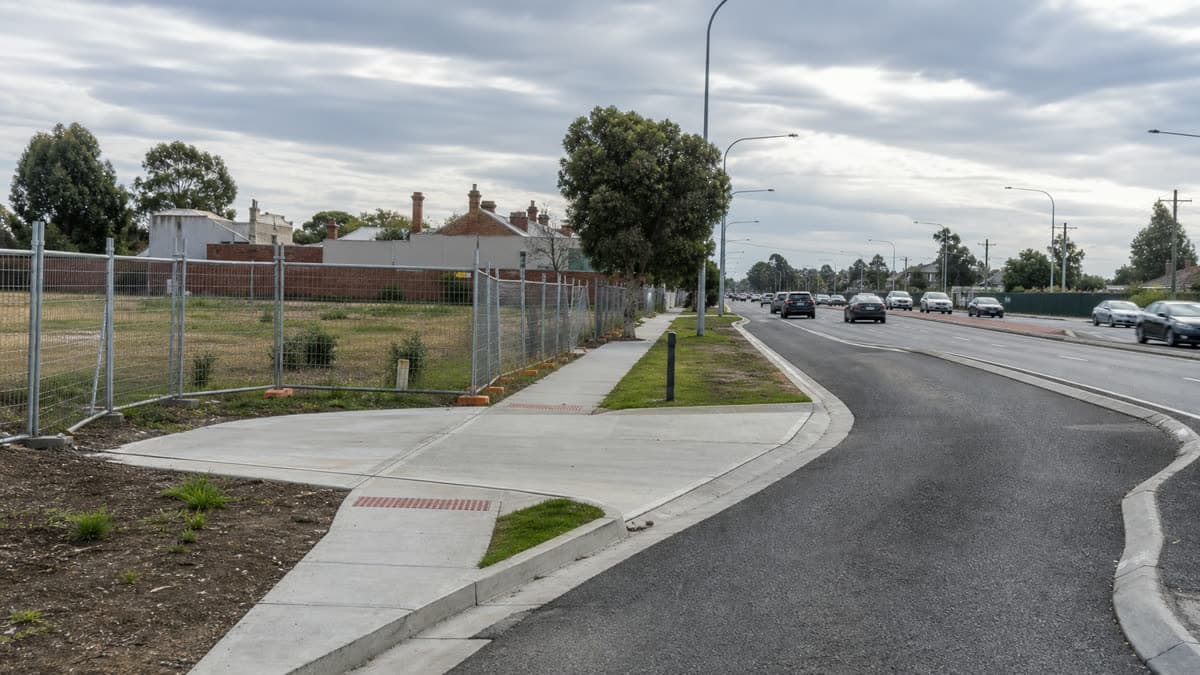
 Photo: SiteLogic editorial image
planning
Clause 52.29: land adjacent to a road zone and access controls
Clause 52.29 requires a permit to create or alter access to a road on the principal road network, referred to the Department of Transport and Planning as a determining authority. This piece explains the trigger, the referral and the design constraints it imposes.
Practitioners still call it "the road zone clause" out of habit, and the habit is not entirely wrong, but the zone it refers to changed structure some years ago and the clause was updated to match. A site fronting a well-travelled arterial can look like a straightforward access design problem until this clause is checked, at which point it becomes a referral, a design constraint and, on some sites, a real threat to yield.
What changed
Victoria's former Road Zone, Categories 1 and 2, and the separate Public Use Zone 4, were consolidated into a single Transport Zone structure, with categories distinguishing state-managed transport corridors from other significant roads. Clause 52.29, formerly framed around Road Zone Category 1, was updated to reference the equivalent Transport Zone category and now applies to land adjacent to that zone, or to land affected by a Public Acquisition Overlay reserved for a road in that category. The clause's common name has not caught up with the zone rename in everyday practice, which is exactly why the current wording of the clause, not the label people use for it, needs to be the reference point for any specific site.
The consolidation was a structural reform to the zone table, not a change in the underlying policy objective. The clause still exists to manage how land fronting the state's most heavily trafficked roads gains or changes access, because uncontrolled ribbon-style access along a principal road corridor degrades both safety and the road's function for through traffic. What changed is the zone name the clause points to and the map layer a title search needs to check, not the reason the control exists.
What applies
Clause 52.29 requires a planning permit to create or alter access to a road in the relevant Transport Zone category, and applies equally to land subject to a Public Acquisition Overlay reserved for such a road. The trigger extends beyond laying a new driveway to altering an existing access, and tribunal decisions over the years have taken different views on how far "create or alter access" reaches, from a narrow reading confined to physical changes at the access point, to a broader reading that has, in some cases, captured a change of use or development where the change would materially alter the volume, frequency or type of traffic using an existing access, even without any physical works at the crossover itself. Because that boundary has moved with case law rather than sitting fixed in the clause text, whether a change of use alone triggers the permit requirement on a specific site is a fact-specific question that needs planning advice, not a general rule to apply from a different project.
Where the clause applies, the road authority responsible for the relevant transport corridor is a determining referral authority under Clause 66, meaning its response binds the outcome rather than merely informing it. If the referral authority objects, the permit must be refused. If it specifies conditions, those conditions must be included in any permit granted. That authority sits within the Department of Transport and Planning, which has taken on the road-management functions previously associated with VicRoads, and the department's guides and resources point to current guidance on how it assesses access proposals referred to it.
Design constraints at the access point
A referral under this clause is rarely a simple approve-or-refuse decision. The referral authority typically tests a proposed or altered access against sight distance at the relevant approach speed, the number and spacing of access points along the frontage, whether a shared or combined access with an adjoining property is achievable in preference to a new individual crossover, the geometry of any turning movements the design would create, and whether the access interacts with an existing intersection, signal phase or planned road upgrade. On a site with meaningful road frontage, these considerations often push a scheme toward fewer, wider, better-located access points rather than several individual crossovers, which can constrain a subdivision layout that assumed each new lot would take direct frontage access.
Where an alternative access exists, for example via a side street or a rear laneway not affected by the Transport Zone, the referral authority commonly expects that alternative to be used instead of a new or altered access onto the principal road, even where the direct frontage access would be more convenient for the layout. That preference is one of the more common reasons a scheme is redesigned after referral rather than refused outright, and it is worth testing in the concept design stage rather than discovering at referral.
How to model it
Treat this clause as a design constraint to resolve at concept stage, not a compliance check to run once the layout is fixed. Where a site fronts a road that may fall within the relevant Transport Zone category, or is affected by a Public Acquisition Overlay for such a road, identify at the earliest feasibility stage whether the intended access point is a new access, an alteration to an existing one, or unaffected by the clause because it uses an existing side or rear access instead. Where a new or altered access is unavoidable, build early engagement with the road authority into the programme rather than the design's referral stage, since access geometry preferences volunteered early are cheaper to design around than conditions imposed after a permit application is already lodged.
Carry programme risk separately from design risk. A determining referral does not only affect whether a permit issues. It affects the referral response time within the overall permit timeline, and a request for a redesigned access adds a design cycle that a fixed-date construction programme rarely absorbs gracefully. Where a subdivision layout depends on each lot having its own frontage access, model an alternative layout using shared or consolidated access points as a fallback, because that is the change most commonly required through this clause's referral process on principal road frontages.
What to check before exchange
Confirm which category of Transport Zone applies to the road along the site's frontage, and whether the clause's trigger is engaged by the access arrangement the concept plan assumes. Check whether a Public Acquisition Overlay affecting a principal road sits over any part of the site, since that overlay alone can bring the clause into play even before any Transport Zone frontage is considered. Review any existing permit history for the site, since a previous access approval may already record conditions, an agreed access point, or a refusal that shapes what a new application can reasonably propose.
Ask whether the road authority has an existing access strategy or corridor plan for the relevant stretch of road, since some corridors have a published or informally understood preference for access consolidation that a scheme should be designed around from the outset rather than discovered through a referral response. Finally, confirm the current departmental guidance and referral practice directly, since responsibility for road-management functions and the specific assessment approach has shifted between agencies as Victoria's transport and planning structures have been reformed.
Published by the SiteLogic Editorial desk. Every fact traces to a primary source. See our standards and corrections register.
Fact-checked: 19 July 2026 · Review by: 19 July 2027
Sources: planning-schemes.app.planning.vic.gov.au · planning.vic.gov.au
Was this useful? Try the tool this post is based on:
Pro on SiteLogic. Logi: up to 60 messages a day. Logi also stops at US$15 of model cost in a Melbourne calendar month. The Developer Comms Kit and unlimited saved projects. The Strategy Lab simulator runs without Pro. Saving a scenario needs a signed-in account. $60/month or $600/year, ex GST. First 3 months are $30/month, ex GST, on monthly Pro.