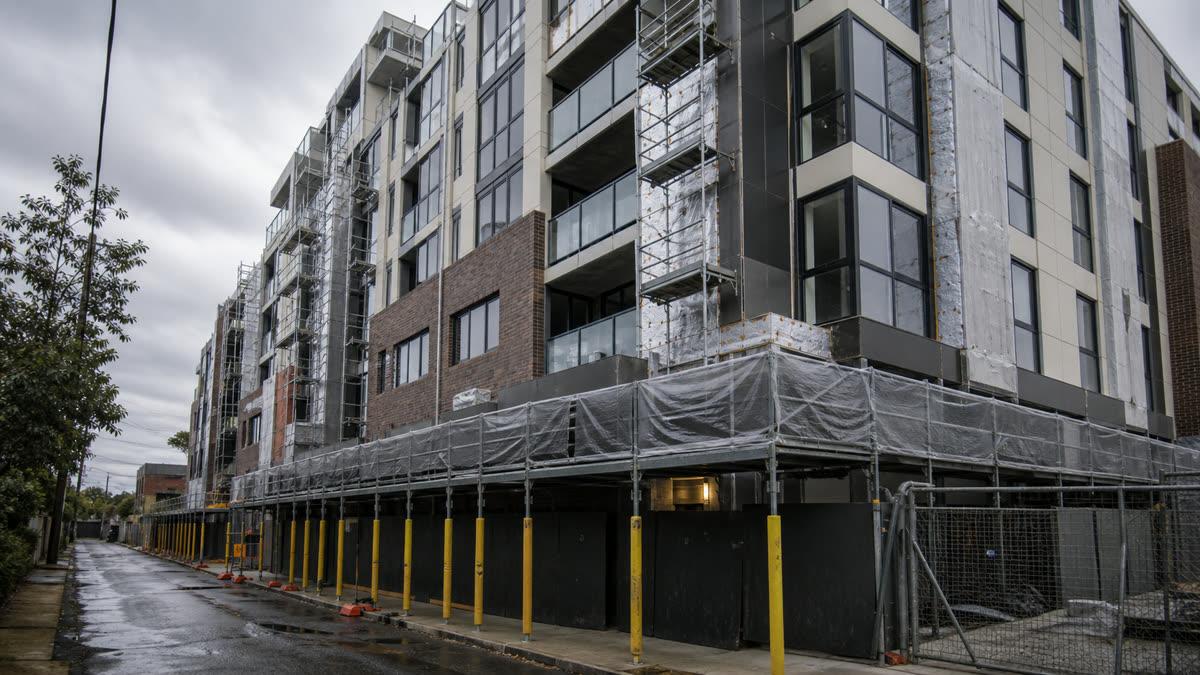
 Photo: SiteLogic editorial image
Cladding Rectification Levy
Cladding Rectification Levy transition: what the 2026 repeal means for permit costs
Victoria has assented to the Cladding Safety Victoria Repeal Act 2026, which replaces the old cladding levy with a lower temporary building permit levy component for some metropolitan Class 2-8 projects. Here is what changes, what stays transitional, and how to carry it in feasibility.
The cladding levy was easy to treat as background permit friction while Cladding Safety Victoria was still running. That is harder to do now. Victoria has assented to the Cladding Safety Victoria Repeal Act 2026, and the replacement levy structure changes who pays, when the new settings bite, and what should sit in a live feasibility for mid-sized and larger apartment or commercial work.
For developers, the useful question is not whether the cladding program was worthwhile. The commercial question is what happens to permit-cost assumptions during the handover from a levy built for rectification work to a lower temporary levy component tied to the wider building reform programme. If that handover is handled loosely, a team can either carry a cost that is about to narrow or understate a permit charge that still applies because the commencement date has not yet arrived.
What changed
The first point is legal timing. The Cladding Safety Victoria Repeal Bill 2026 passed both Houses on 12 May 2026 and received Royal Assent on 19 May 2026. But the Act does not operate from assent alone. Its commencement clause says it starts on a proclaimed day, with a backstop of 1 July 2027 if not proclaimed earlier.
That matters because the repeal is real, but it is still a transition, not a switch that has already flipped on every live project. Until the operative provisions commence, permit-cost assumptions should not pretend the old levy settings have disappeared.
The second change is structural. The Act repeals the Cladding Safety Victoria Act 2020, abolishes Cladding Safety Victoria, and transfers its property, rights and liabilities to the Victorian Building Authority. It also creates a cladding account within the Building account so money connected to the remaining cladding functions can still be carried and spent under the amended framework.
The third change is the levy rewrite itself. The Act replaces the former cladding-specific permit levy setting with a new additional building permit levy amount for non-regional buildings. The explanatory material says the replacement levy is lower, temporary, and aimed at funding the continuing building-system work after the cladding rectification programme winds down.
What applies
The official building reform page says the replacement levy applies only to certain building types with a cost of building works of $1.5 million or more. The bill material states that more precisely as Class 2 to Class 8 buildings in metropolitan areas, with domestic houses, Class 9 buildings, Class 10 buildings and non-metropolitan work outside that additional levy net.
The explanatory memorandum also sets the new rate. It says the additional levy under new section 205G(2E) is calculated at 0.37 cents for every dollar of the cost of the relevant building work, subject to the disaggregation rules for mixed-class projects. In plain terms, the new component still belongs in permit-cost planning, but it is not meant to be a clone of the former cladding levy.
The other important limit is time. The same explanatory material says the new levy component applies up to and including 30 June 2029. So this is not an open-ended permanent tax line. It is a dated transition setting.
The State's own public explanation is that the new structure reduces the total levy burden on affected projects by between 47 per cent and 66 per cent. That is useful, but it is not a licence to cut every permit-cost allowance by half. The reduction only matters if the project is one of the projects that moves into the new regime once commencement occurs. If the job sits outside the new class and location filters, the right answer may be that the replacement component does not apply at all. If the permit event happened before repeal takes effect, transitional treatment may still carry the former rules.
That transitional point is explicit in the Act. Section 288B keeps the old levy machinery operating for permit applications made before the repeal of the former provision, and for certain notice-based cases tied to work carried out before that repeal. In practice, the deal date alone is not enough. The critical event is the permit and levy event timing against commencement.
How to model it
The cleanest way to model the change is to separate three questions instead of treating "the cladding levy" as one fixed line item.
First, ask whether the project is in the replacement cohort at all. If the work is not in the affected building classes, is outside the metropolitan filter used in the legislation, or sits below the $1.5 million threshold, the new additional levy component may not belong in the model.
Second, ask which timing regime applies. A project being marketed or exchanged after Royal Assent does not automatically mean it will pay under the new formula. The Act still needs commencement, and the transitional provisions preserve the old rules for some earlier levy events. For a live feasibility, that means the permit programme should be aligned with the legal commencement path, not with headlines about the bill passing.
Third, ask what the lower rate changes in the residual. A reduced permit levy does improve gross development margin at the edge, but it does not change the bigger commercial risks around financing, construction pricing or builder performance. The sensible use of the saving is to price the permit-cost line correctly, not to let a thinner levy justify a more aggressive land bid.
For mixed-class projects, be careful with cost allocation. The explanatory memorandum says the amount must not include costs that relate to Class 1, 9 or 10 work when the project includes those alongside the affected classes. That is a practical modelling issue on podium, mixed-use and staged work. If the permit-cost worksheet uses one blended cost base for every class on site, it can overstate the new levy.
What to check before exchange
Start with the permit pathway, not the media summary.
First, confirm whether the likely building permit falls after the repeal provisions commence. If not, the old levy machinery may still be the operative one for the relevant levy event.
Second, test the class and geography assumptions. The replacement levy is not a universal Victoria-wide permit charge. The public material is clear that it is aimed at specified Class 2 to 8 work and does not extend to every building class or to non-metropolitan work.
Third, check the cost-of-works threshold using the permit-cost basis the legislation expects, not the rounded acquisition model number. The threshold is $1.5 million, so borderline projects need a tighter estimate than a desktop feasibility often carries at heads-of-terms stage.
Fourth, if the project mixes building classes, make sure the quantity surveyor or permit adviser can disaggregate the relevant costs. That is where a levy that looks smaller in principle can still be overstated in practice.
Finally, record the assumption directly in the investment paper. If the model assumes the new 0.37 cent rate, say that the assumption depends on commencement and on the project fitting the affected class, location and threshold tests. If the model assumes the pre-repeal position, say why. A dated transition is manageable when the assumption is written down and easy to lose once the deal team starts speaking in shorthand.
The commercial takeaway is plain. Victoria has legislated the end of the old cladding levy structure, but the replacement is narrower, temporary and timing-sensitive. That means the right feasibility response is not to delete the permit-cost line. It is to re-test whether the project is actually in the new cohort, and when.
Published by the SiteLogic Editorial desk. Every fact traces to a primary source. See our standards and corrections register.
Fact-checked: 13 June 2026 · Review by: 13 June 2027
Sources: Cladding Safety Victoria Repeal Act 2026 (Vic) · Cladding Safety Victoria Repeal Bill 2026 - Explanatory Memorandum · Planning Victoria - Building reform
Was this useful? Try the tool this post is based on:
Pro on SiteLogic. Logi: up to 60 messages a day. Logi also stops at US$15 of model cost in a Melbourne calendar month. The Developer Comms Kit and unlimited saved projects. The Strategy Lab simulator runs without Pro. Saving a scenario needs a signed-in account. $60/month or $600/year, ex GST. First 3 months are $30/month, ex GST, on monthly Pro.