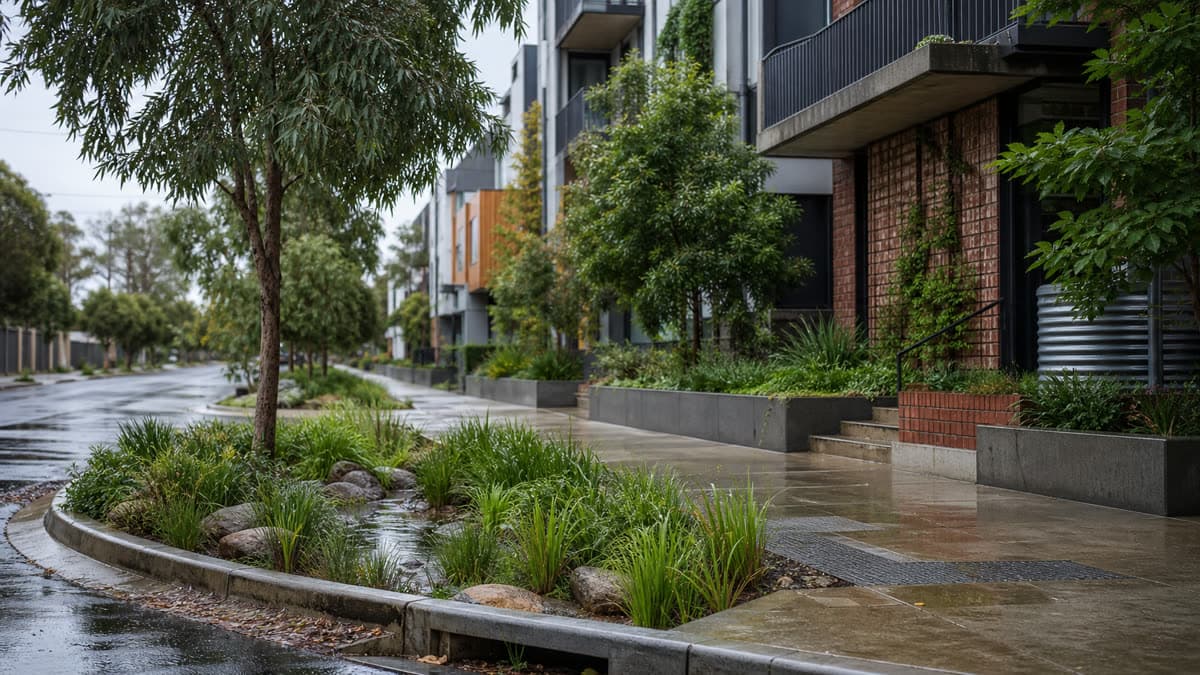
 Photo: SiteLogic editorial image
Climate Adaptation
Victoria's draft Built Environment Adaptation Plan 2027–31: what belongs in feasibility now
The draft 2027–31 plan points to stronger climate-risk information and planning responses, but it is not a new development standard. Developers should stress-test hazard exposure without inventing a future compliance cost.
Victoria's draft Built Environment Adaptation Action Plan for 2027–31 is a direction-setting document, not a new building code or planning overlay. That distinction matters for feasibility. The draft is evidence that government is continuing to focus on heat, bushfire, flood, storm, drought and coastal risk. It is not evidence for inserting an invented compliance percentage into every construction budget.
The useful response is to test whether a project already depends on climate assumptions that are weak, old or hidden. The wrong response is to price a policy headline as if a final statutory control has been made.
Current status
The Department of Transport and Planning page says consultation on the draft 2027–31 plan ran from 18 June to 15 July 2026. It says the Department will consider feedback before the final plan is settled.
The plan is being prepared under the Climate Action Act 2017. The Victorian Government's Act summary explains that adaptation action plans are required for systems that are vulnerable to climate impacts or essential to Victoria's preparedness, and that they are prepared on a five-year cycle.
As at 18 July, the 2027–31 built-environment plan remains a draft. A feasibility should say that plainly. Consultation closing does not make the draft final, and a strategic action plan does not automatically amend a planning scheme or the National Construction Code.
What the public material signals
The DTP page identifies bushfires, heatwaves, drought, storms and intense rainfall as built-environment risks. It also lists work already underway: flood guidance, coastal inundation mapping, heat-vulnerability mapping, planning and building responses to bushfire, mid-rise sustainability settings and energy-infrastructure resilience.
The broader adaptation-plan page places the built environment alongside other systems including water, transport, energy and the natural environment. For a developer, that cross-system view is important. A site can have a workable building envelope and still carry delivery risk through drainage, road access, power resilience or emergency response.
The 2026–30 Climate Change Strategy says the new adaptation plans are being prepared in 2026 and will be shaped by the strategy. That makes the draft a credible planning signal. It still does not tell a quantity surveyor what a future project-specific measure will cost.
What belongs in feasibility now
First, use current controls and current evidence. If land is affected by a flood, bushfire, coastal or other hazard control today, model the requirement that operates today. Do not wait for the final adaptation plan to recognise a mapped risk already visible in the planning scheme or authority advice.
Second, add a climate-design sensitivity where the project programme is long. A five-year development may move through design, permit, finance and construction while guidance or standards change. The sensitivity should identify the exposed design packages rather than applying one unexplained contingency to the whole build.
For heat, that may mean testing glazing, shading, landscape, cooling demand, plant capacity and common-area comfort. For intense rainfall, it may mean reviewing the drainage basis, floor levels, overland flow paths, basement entries and temporary works. For bushfire, it may mean access, water supply, defendable space, material selection and construction sequencing. For coastal risk, it may mean the planning horizon and data source used in the site's hazard assessment.
These are scoping questions. The cost should come from the relevant consultant and design response, not from the adaptation plan's title.
Programme risk is as important as capital cost
Climate exposure can change the order of work. A drainage authority response may need to arrive before a basement design is fixed. A bushfire assessment may alter the layout before civil drawings are coordinated. An environmental or resilience requirement introduced after design development can send several disciplines back through the same package.
The programme should therefore include decision points: when the hazard data will be confirmed, who owns the design response, and which later packages cannot proceed until that response is stable.
This is more useful than a broad "climate allowance" because it shows where delay can occur. Holding cost often comes from a late design loop rather than from the price of one additional building element.
Procurement and lender questions
The adaptation plan is also a prompt to tighten consultant scopes. A civil, fire, building-services or ESD brief should state the hazard information and design horizon it relies on. If the consultant is only assessing present-day conditions, the development team should know that before using the report for a long-dated project.
Ask the insurer and financier what evidence they expect for an exposed site. These are not planning controls. They can affect finance conditions, deductibles, cover or the information needed before approval. Do not claim a premium outcome without a project-specific quotation.
For design-and-construct procurement, allocate responsibility for changes in statutory requirements and for site information that proves incomplete. A strategic government plan does not settle that risk between principal and contractor.
What to check before committing land value
Confirm the plan's status at the date of the investment decision. When the final 2027–31 plan is published, compare its final actions with the consultation draft rather than assuming they are identical.
List the site's current hazard sources and the date of each report. Old flood, bushfire or coastal work should not be treated as current merely because it once supported a permit.
Map each material hazard to a feasibility line: yield, consultant scope, construction cost, programme, finance, insurance or exit risk. If a risk cannot be connected to one of those lines, the team may be discussing policy without changing the decision.
Finally, keep the conclusion proportionate. The draft plan does not prove that every Victorian project will face a new cost in 2027. It does show that climate resilience remains an active government workstream. A credible feasibility responds by exposing project-specific assumptions now and updating them when final actions become operative controls, standards or funded programmes.
Published by the SiteLogic Editorial desk. Every fact traces to a primary source. See our standards and corrections register.
Fact-checked: 18 July 2026 · Review by: 18 July 2027
Sources: planning.vic.gov.au · climatechange.vic.gov.au · climatechange.vic.gov.au · climatechange.vic.gov.au
Was this useful? Try the tool this post is based on:
Pro on SiteLogic. Logi: up to 60 messages a day. Logi also stops at US$15 of model cost in a Melbourne calendar month. The Developer Comms Kit and unlimited saved projects. The Strategy Lab simulator runs without Pro. Saving a scenario needs a signed-in account. $60/month or $600/year, ex GST. First 3 months are $30/month, ex GST, on monthly Pro.