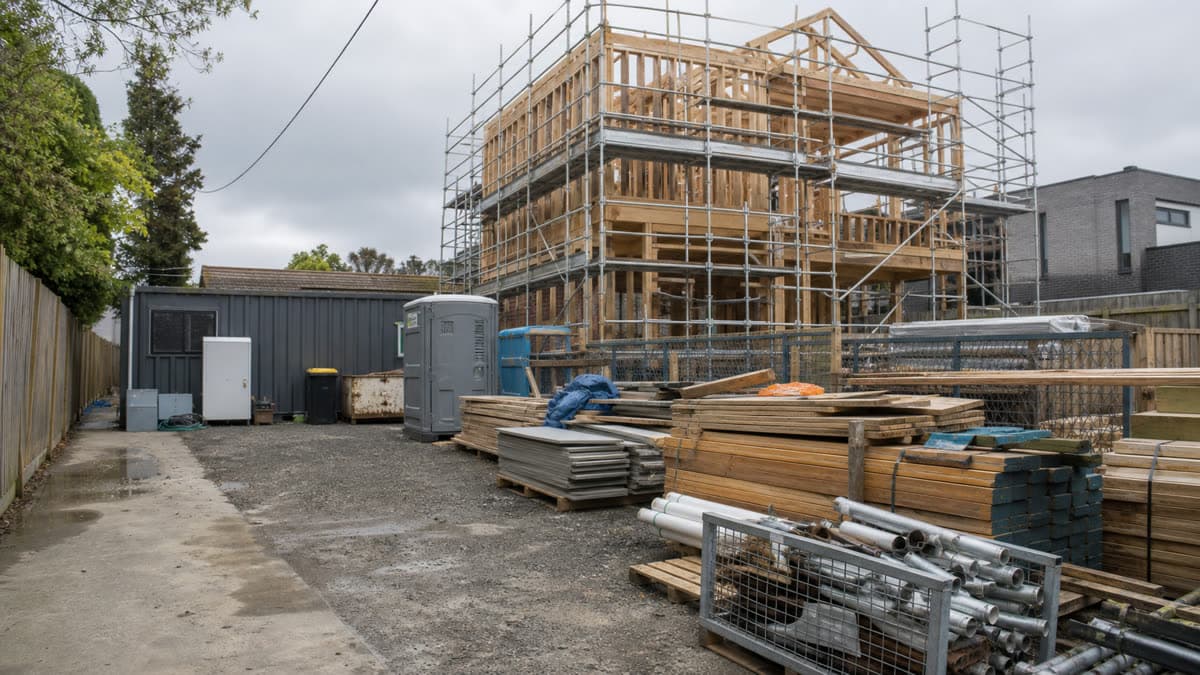
 Photo: SiteLogic editorial image
Construction Costs
Builder margin and preliminaries: what is in the build cost
A headline build rate blends trade costs, preliminaries, margin and overhead into one figure. How to separate the components, read them against contract type under the Domestic Building Contracts Act, and model them properly in a feasibility.
A headline build rate quoted as a dollar figure per square metre is one of the most commonly misused numbers in a development feasibility, because it compresses several very different cost categories, trade costs, preliminaries, builder's margin and overhead, into a single figure that looks precise but hides where the money actually goes. A developer who treats that headline rate as a fixed, verified cost rather than an estimate built from separate components is exposed to a build cost that moves once a contract is actually negotiated and signed.
What is in a headline build rate
A build rate is an aggregate of several distinct cost categories. Trade costs cover the physical construction: the actual labour and materials for each trade package, from earthworks and concrete through to fit-out and finishes. Preliminaries cover the cost of running the site itself rather than building anything specific: site supervision, scaffolding, temporary services, site sheds, waste management and the builder's own project management time. Margin is the builder's return for taking on the risk and management of the contract. Overhead covers the builder's own business costs, insurance, licensing and corporate overhead, allocated across the project. A benchmark figure that blends all four into one number is useful for an early, order-of-magnitude estimate, but it should not be relied on once a project moves toward a signed contract.
What applies: separating the components
Benchmark costings published for infrastructure and development planning purposes, such as those referenced in the VPA's infrastructure contributions plans material, are built for a specific purpose, generally to support levy calculations or precinct-level cost estimates, and are not a substitute for a quantity surveyor's trade-by-trade estimate on a specific project. When a builder or a quantity surveyor breaks a project cost plan down properly, trades are itemised individually, preliminaries are shown as a separate percentage or line item, margin is disclosed as a percentage of the cost base, and overhead is either folded into margin or shown separately depending on the builder's own costing convention. A developer should ask for this breakdown rather than accept a single blended rate, because the breakdown is what reveals where a builder has priced conservatively and where a rate looks optimistic.
How to model it: contract structure and where the risk sits
The form of building contract used also affects how these categories behave once construction starts. Contracts governed by the Domestic Building Contracts Act 1995 set requirements for cost-plus and fixed-price arrangements on domestic building work, including disclosure obligations around prime cost and provisional sum items, the allowances built into a fixed-price contract for items not yet fully specified at the time of signing. A fixed-price contract shifts the risk of a trade cost overrun onto the builder, in exchange for a margin that reflects that risk. A cost-plus contract shifts the same risk onto the developer, in exchange for a lower headline margin. Neither structure is inherently better. A feasibility built on a fixed-price quote should not also assume the cost-plus level of margin, because the two price different risk allocations, and mixing the two produces a cost stack that understates the true position either way.
A feasibility should carry trade costs, preliminaries, margin and overhead as separate line items wherever the underlying cost plan supports it, rather than a single blended rate, because that separation is what allows a developer to see which component moves if the design changes, the market for trades tightens, or the contract structure shifts. Preliminaries and margin, in particular, tend to move as a percentage of the trade cost base, so if trade costs rise during design development, a feasibility that only updates the headline rate risks understating the preliminaries and margin that rise proportionally alongside them.
What to check before signing a contract
Before signing, a developer should obtain a proper trade-by-trade cost plan from a quantity surveyor rather than rely on the builder's headline quote alone, confirm which contract form is proposed and what that implies for prime cost and provisional sum treatment under the Domestic Building Contracts Act, and check what allowance has actually been made for items still undesigned at the point of signing. Provisional sums in particular deserve scrutiny, because an item priced as a provisional sum can land well above the allowance once it is finally specified, and that gap flows straight through to the project's actual cost rather than the feasibility's assumed cost.
It is also worth asking the builder directly how preliminaries are calculated, as a fixed dollar figure for the program length quoted or as a percentage of trade cost, because the two methods behave differently if the program extends. A preliminaries figure fixed at tender can leave the developer exposed if the actual build takes longer than quoted and the contract allows the builder to claim additional time-related costs, whereas a percentage-based figure moves automatically with the trade cost base but not necessarily with program length. Neither approach is wrong, but a developer should know which one applies before relying on the headline preliminaries figure in a feasibility.
Interaction with other cost lines
Builder margin and preliminaries do not sit in isolation from the rest of the feasibility. A longer construction program, whether from a more complex apartment build or a permit condition that adds sequencing steps, extends the period over which preliminaries are charged, because site supervision and site running costs are largely time-based rather than fixed. Similarly, a scope change driven by a planning condition, an additional acoustic or structural requirement, for example, changes the trade cost base and therefore the dollar value of a margin calculated as a percentage of that base, even where the margin percentage itself stays the same. Treating these categories as connected rather than fixed inputs avoids a feasibility that looks stable on paper while the underlying build program is actually extending.
Record keeping and review
Once construction starts, the discipline does not stop at the signed contract. Variations, provisional sum reconciliations and any claims under the contract should be tracked against the original cost plan line by line, not against the single headline rate, so that a developer can see early whether the actual build cost is tracking to the components that were priced or moving away from them in a specific trade or preliminaries category. A build cost that looks fine in aggregate can still be quietly eroding margin if one component, a provisional sum item or a preliminaries blowout from an extended program, is running well over its original allowance, and the only way to catch that early is to keep the components separate rather than watch a single blended figure.
Published by the SiteLogic Editorial desk. Every fact traces to a primary source. See our standards and corrections register.
Fact-checked: 19 July 2026 · Review by: 19 July 2027
Sources: vpa.vic.gov.au · legislation.vic.gov.au
Was this useful? Try the tool this post is based on:
Pro on SiteLogic. Logi: up to 60 messages a day. Logi also stops at US$15 of model cost in a Melbourne calendar month. The Developer Comms Kit and unlimited saved projects. The Strategy Lab simulator runs without Pro. Saving a scenario needs a signed-in account. $60/month or $600/year, ex GST. First 3 months are $30/month, ex GST, on monthly Pro.