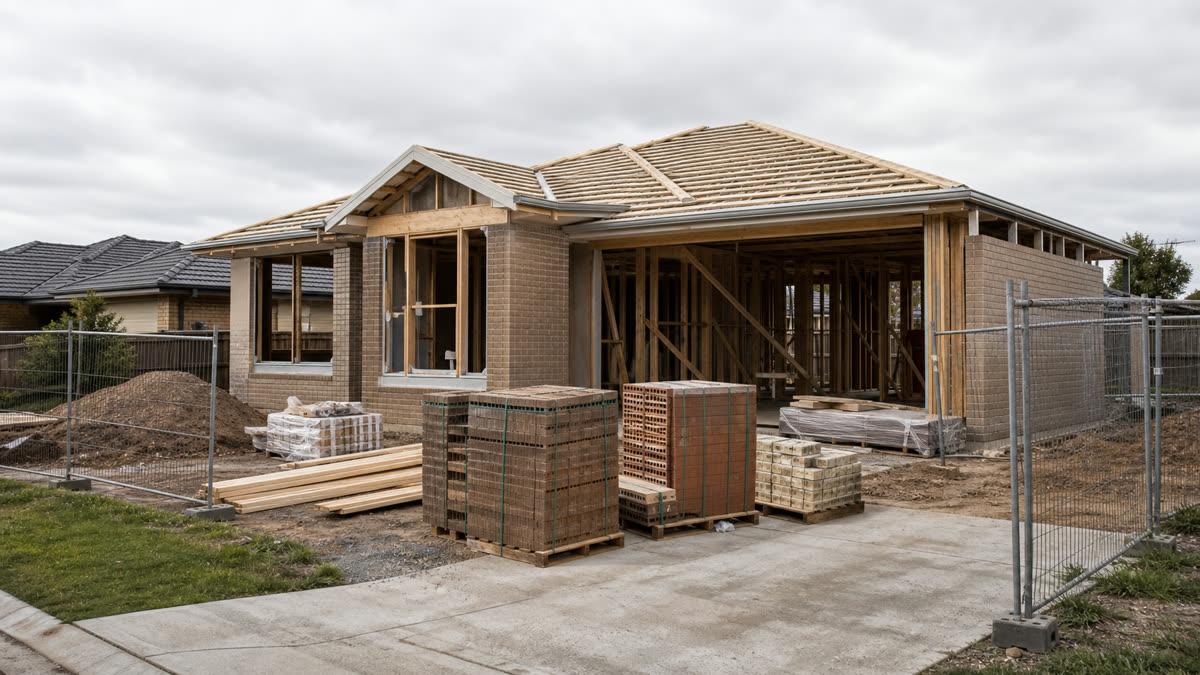
 Photo: SiteLogic editorial image
Building and Plumbing Commission
BPC and Home Warranty: what Victoria's first-resort insurance shift means for builder risk
Victoria's Building and Plumbing Commission has already combined regulation, disputes and domestic building insurance. From 1 July 2026, Home Warranty replaces the old last-resort DBI model for eligible low-rise domestic work. Here is what changes, what stays, and how to carry it in feasibility and contract timing.
Victoria's domestic building insurance system is moving through a bigger change than a name swap. The Building and Plumbing Commission, or BPC, is already operating as the combined regulator for building, plumbing, dispute resolution and domestic building insurance. That step landed on 1 July 2026, when Home Warranty replaced the older Domestic Building Insurance model for eligible low-rise domestic work.
For developers, insurance settings reach further than homeowner protection. They shape who can contract, when a certificate has to be in place, how much counterparty risk sits with the builder, and what assumptions belong in a townhouse or low-rise delivery programme. The old scheme was narrow enough that many project teams treated the insurance certificate as a compliance checkbox and did the real risk work elsewhere. The new structure improves cover for owners, but it does not remove the need to test builder strength, contract sequencing or replacement risk before the site moves from permit to build.
What changed
The first change has already happened. BPC says it is Victoria's new regulator for the building and plumbing industries, combining the functions of the Victorian Building Authority, Domestic Building Dispute Resolution Victoria and the domestic building insurance function of the Victorian Managed Insurance Authority. In practical terms, the state has moved regulation, dispute resolution and insurance into one agency.
That matters because the old consumer journey was fragmented. A registration issue, a workmanship dispute and an insurance question could sit with different bodies. BPC's published material says the purpose of centralising those functions is greater oversight of the consumer journey and stronger consumer protection. For a developer or builder, the practical consequence is that insurance is no longer sitting on the edge of the system. It is now part of the same regulatory architecture that handles licensing, complaints and enforcement.
The second change is the July 2026 insurance transition. Home Warranty replaced Domestic Building Insurance on 1 July 2026. BPC's announcement describes it as mandatory cover that builders must purchase on behalf of the homeowner for domestic building projects up to 3 storeys and valued at more than $20,000.
That date still matters in live transactions. A project that exchanged before 1 July 2026 and moved into contract administration after it may straddle two insurance settings, depending on when the relevant certificate was issued and which regime applies to the work. The article is not legal advice on that handover point. It is a reminder that insurance timing now belongs on the same pre-contract checklist as registration, security, programme and finance conditions.
What applies
The older DBI position still matters for work insured before the changeover. BPC's FAQs say DBI was mandated for residential building work over $16,000. Its cover page says policies issued on or after 1 July 2014 generally provide up to $300,000 in cover per home, while older policies carry the lower pre-2014 limit.
That DBI trigger is narrow. BPC says a policy is triggered when the builder dies, disappears or becomes insolvent, and for policies issued on or after 1 July 2015, when the builder fails to comply with a Tribunal or Court order. That is why the existing scheme is often described as last-resort insurance. If the builder is still standing but the work is defective and the dispute has not crossed one of those thresholds, the policy does not behave like a broad first-response defect fund.
Home Warranty is meant to move that line. BPC's May 2026 announcement says the scheme also covers incomplete, defective or non-compliant work where the builder is unable or unwilling to complete or fix the work. The same announcement puts the maximum cover available at $400,000.
Two boundaries still matter. First, BPC's published announcement frames the new cover around domestic building projects up to 3 storeys and more than $20,000 in value. That means low-rise townhouse and similar domestic product is the clear target case. It also means teams working on taller product should not assume the same scheme treatment without checking the applicable contract and insurance position directly.
Second, BPC says all existing DBI policies issued before 1 July 2026 remain current under their existing terms and conditions. So the transition is not wiping old certificates off the map. It is creating two policy cohorts that may sit inside a developer's portfolio at the same time: older projects still governed by DBI terms, and later eligible projects governed by Home Warranty.
How to model it
The useful modelling change is not to assume the insurance reform removes builder risk. It changes where that risk sits and when it becomes visible.
Under the old DBI model, the commercial exposure sat heavily in builder selection and contract security because policy access was narrow. If the builder underperformed but had not yet crossed a trigger event, the developer could still be carrying programme slippage, superintendent disputes, rework pressure and lender concerns long before any insurance outcome became relevant.
Under Home Warranty, homeowner protection is broader on paper, but the delivery consequences still arrive first. A builder who is unwilling or unable to fix work can still slow settlements, tie up trades and force redesign or replacement decisions before an insurance outcome closes the gap. For feasibility, the right response is not to delete contingency because the cover looks stronger. It is to separate the risk buckets more clearly.
Start with the direct insurance and compliance bucket. BPC has published the coverage structure and threshold settings, but the public material does not offer a universal premium table that can be dropped into a feasibility model. So use live quote space rather than a made-up standard rate.
Then carry a programme bucket. On low-rise domestic product, treat insurance evidence, certificate timing and builder eligibility as programme gates rather than admin afterthoughts, particularly on contracts written either side of the 1 July 2026 changeover. This is an inference from BPC being the sole provider since 1 July 2026 and from the change in scheme rules. A single-provider transition can compress timing tolerance if documents are left late.
After that, keep a replacement-and-rectification bucket. Broader homeowner cover does not mean a developer escapes every cost linked to defective or incomplete work. Time, supervision, preliminaries, consultant time, financier conditions and purchaser management can still move even when the insurance framework is better than it was before.
The practical lesson is plain. Home Warranty should reduce the severity of some downstream homeowner loss scenarios. It should not be treated as a reason to relax counterparty screening on the way into contract.
What to check before exchange
First, confirm whether the project clearly fits the published Home Warranty case. BPC's current announcement is for domestic building projects up to 3 storeys and over $20,000. If the product or procurement path sits near the edges of that description, check the insurance position directly before assuming the new cover solves the issue.
Second, map the contract date against the policy date. A June 2026 contract pack and a July 2026 commencement can create lazy assumptions inside the team if nobody has nominated which insurance regime is meant to apply and when evidence must be in hand.
Third, keep doing the ordinary builder due diligence. BPC's own material still describes insurance as mandatory and ties it to builder eligibility, certificates and claims structure. That means registration status, dispute history, financial pressure and insurance evidence still deserve review before the contract becomes unconditional.
Fourth, treat existing DBI policies as live legacy assets, not obsolete paperwork. BPC says policies issued before 1 July 2026 remain current on their own terms. If a staged site or related-party portfolio holds older certificates, make sure the team knows which claims framework belongs to which project.
Finally, record the assumption in the investment paper. If the feasibility relies on Home Warranty being available, say that explicitly and note the project type, height and timing basis for that view. If the project is still inside the older DBI cohort, say that too. Insurance transitions are manageable when they are named early and hard to unwind when everyone thinks somebody else checked them.
The commercial point is measured rather than dramatic. Victoria is moving from a narrow last-resort insurance model toward broader cover for eligible domestic projects, and it is doing that inside a regulator that now combines licensing, dispute resolution and insurance. That is a meaningful consumer-protection reform. It is also a reminder that low-rise delivery risk still lives upstream in builder choice, programme discipline and contract timing.
Published by the SiteLogic Editorial desk. Every fact traces to a primary source. See our standards and corrections register.
Fact-checked: 12 June 2026 · Review by: 12 June 2027
Sources: Building and Plumbing Commission - About · Building and Plumbing Commission - FAQs · Building and Plumbing Commission - What's covered? · Building and Plumbing Commission - Home Warranty insurance coming soon
Was this useful? Try the tool this post is based on:
Pro on SiteLogic. Logi: up to 60 messages a day. Logi also stops at US$15 of model cost in a Melbourne calendar month. The Developer Comms Kit and unlimited saved projects. The Strategy Lab simulator runs without Pro. Saving a scenario needs a signed-in account. $60/month or $600/year, ex GST. First 3 months are $30/month, ex GST, on monthly Pro.