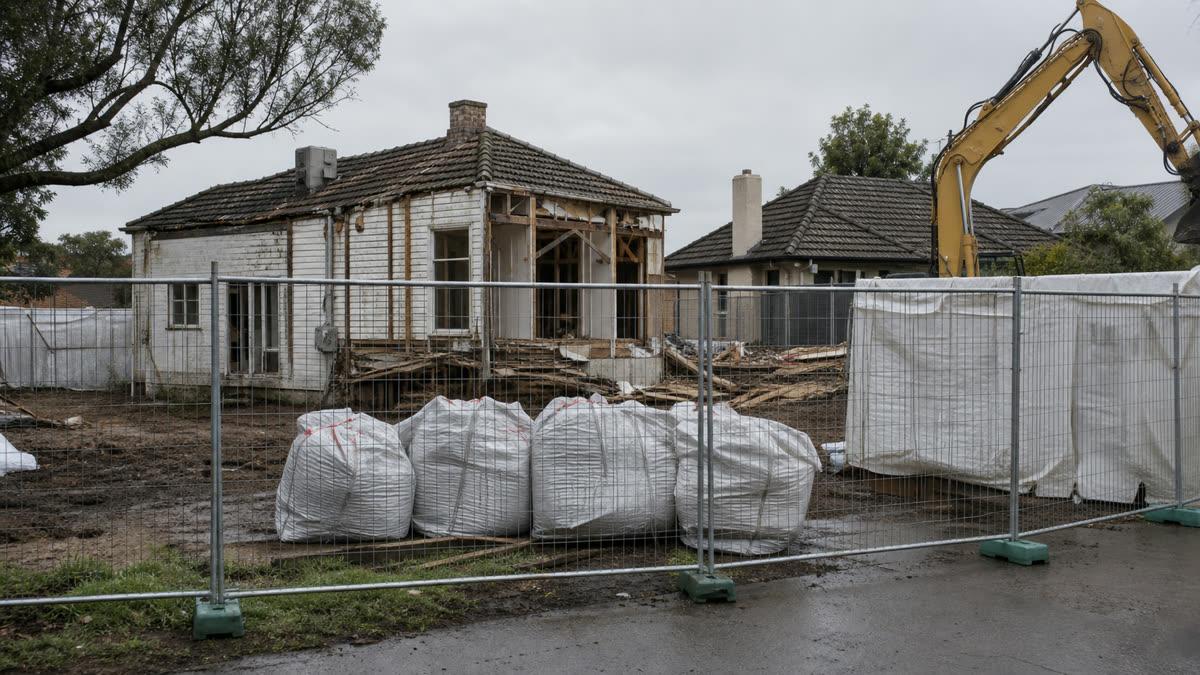
 Photo: SiteLogic editorial image
Construction Costs
Asbestos in demolition: WorkSafe duties and cost
The asbestos duties that apply before demolition or refurbishment under Victorian OHS law, how the survey and removal pathway works, and why unpriced asbestos risk is a common source of program and cost blowout on infill sites.
A large share of Victorian infill sites carry an existing dwelling or shed built well before asbestos-containing materials were phased out of common use, and the cost of dealing with that material properly is one of the most frequently underpriced line items in a demolition budget. It is not an optional extra. It is a statutory duty that sits ahead of the demolition itself, and it needs to be modelled before the site is bought, not discovered once the excavator turns up.
What applies
Demolition and refurbishment work in Victoria is governed by the Occupational Health and Safety Regulations 2017, which impose specific duties in relation to asbestos on employers and persons who manage or control the workplace, which in a demolition context typically includes the demolisher and the head contractor. WorkSafe Victoria's asbestos guidance sets out how those duties apply in practice.
The starting duty is identification. Before demolition or refurbishment work begins, the duty holder must ensure that a proper assessment is carried out to determine whether asbestos or asbestos-containing material is present, or is likely to be present, in the structure to be worked on. That assessment cannot simply be assumed based on the age of the building; it needs to be carried out by a suitably qualified person, and it needs to occur before the disturbance, not after.
Where asbestos is identified, or where it cannot be ruled out, the duty holder needs to manage the material appropriately before demolition can safely proceed. That includes controlling how the material is handled, ensuring it is not disturbed by unqualified trades, and ensuring the removal itself is carried out by people licensed to do so.
The duties before demolition
Removal work above the regulatory thresholds must be carried out by a licensed asbestos removalist, with the class of licence required depending on the type and quantity of material involved. Friable asbestos, material that can be crumbled by hand and therefore poses a higher airborne fibre risk, generally sits in the most tightly controlled category. Non-friable, bonded material such as older fibro sheeting is subject to its own licensing thresholds depending on quantity.
Removal work of the kind typically encountered on a demolition site generally needs to be notified to WorkSafe before it starts, giving the regulator visibility of when and where licensed removal is occurring. Once removed, the material must be disposed of at a facility licensed to accept asbestos waste, with the transport and disposal chain itself subject to control, not left to informal arrangement between the demolisher and a general waste contractor.
None of this is a paperwork exercise layered on top of an otherwise straightforward demolition. It changes who can do the work, in what sequence, and what has to happen before the rest of the demolition contractor's program can start.
How to model the cost
The cost of managing asbestos correctly has several distinct components, and a feasibility that lumps them into a single demolition allowance tends to understate the real number. There is the identification survey itself, the cost of licensed removal, which varies by licence class and the volume and accessibility of the material, and the cost of compliant transport and disposal.
The following figures are illustrative. They demonstrate the method and will vary by site, council and timing. A single older dwelling on an infill site might carry an asbestos survey cost in the low hundreds to low thousands of dollars, depending on the size and complexity of the building. If the survey finds a modest quantity of bonded, non-friable material such as old fibro sheeting, licensed removal and disposal might add several thousand dollars to the demolition cost. If friable material is found, for example in aged pipe lagging or degraded sheeting, the removal cost can be substantially higher again, and the removal program itself can take considerably longer because of the more stringent containment and clearance requirements involved. These figures illustrate the method only; the real cost on any given site depends on the quantity, condition and type of material found, and should be confirmed with a licensed assessor and removalist before it is locked into a feasibility.
Program risk
The program risk compounds where asbestos is discovered rather than anticipated. A demolition that assumes no asbestos, and then encounters friable material once work has started, faces a stop-work scenario: the site needs to be secured, the material assessed, a licensed removalist engaged, and clearance certification obtained before ordinary demolition can resume. That sequence, run reactively under time pressure, is more expensive and slower than the same removal planned into the program from the outset.
This risk is highest on older established-suburb infill sites, where the existing improvements predate contemporary building material regulation by decades, and lowest, though not absent, on more recently built stock. The presence of outbuildings, sheds, garages and fencing on a site is a common blind spot: these structures are frequently assessed less rigorously than the main dwelling, despite often containing the same era of construction material.
Underground services can carry the same risk. Older stormwater and sewer connections, and some in-ground drainage products, were manufactured with asbestos cement, and works that disturb them during site preparation can trigger the same duties as demolishing a structure above ground. A scope of works that only assesses the visible building, and ignores what might be run underground, has not actually closed out the risk.
What to check before exchange
Treat the asbestos question as a mandatory due diligence step on any site with existing improvements predating current building practice, not an assumption to be resolved after settlement.
First, commission a pre-purchase asbestos assessment on any site with existing structures, covering outbuildings and fencing as well as the main dwelling, ideally before the offer is finalised.
Second, if asbestos is identified, get a quote from a licensed removalist for the specific quantity and type found, rather than relying on a rule-of-thumb allowance from a different project.
Third, build the removal program, including any WorkSafe notification lead time, into the overall demolition and construction schedule rather than assuming demolition can start the day access is granted.
Fourth, confirm the disposal pathway and cost with the removalist, since transport distance to a licensed facility can materially affect the price.
Fifth, keep the assessment, removal certification and disposal documentation on file. It protects the developer if a dispute arises later about what was present, what was removed, and how it was handled.
Asbestos on a demolition site is common, manageable and priceable. The costly version of the problem is the one that is not identified until the demolition crew is already on site.
Published by the SiteLogic Editorial desk. Every fact traces to a primary source. See our standards and corrections register.
Fact-checked: 19 July 2026 · Review by: 19 July 2027
Sources: worksafe.vic.gov.au · legislation.vic.gov.au
Was this useful? Try the tool this post is based on:
Pro on SiteLogic. Logi: up to 60 messages a day. Logi also stops at US$15 of model cost in a Melbourne calendar month. The Developer Comms Kit and unlimited saved projects. The Strategy Lab simulator runs without Pro. Saving a scenario needs a signed-in account. $60/month or $600/year, ex GST. First 3 months are $30/month, ex GST, on monthly Pro.