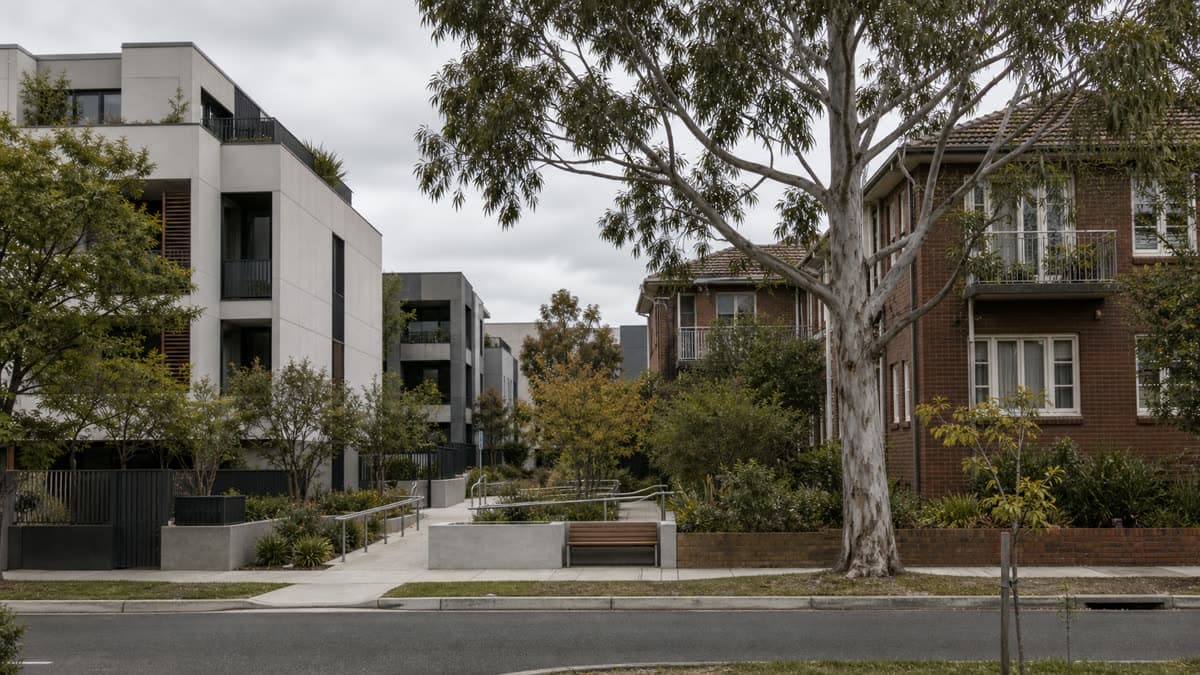
 Photo: SiteLogic editorial image
Affordable Housing
Affordable housing and inclusionary zoning in Victoria: what exists now, and what may be coming
Victoria already has planning tools that can secure affordable housing, but it does not yet have a simple statewide inclusionary zoning rule. Here is what the current framework does, what Plan for Victoria says may change, and how to carry that risk in a feasibility.
Affordable housing has moved from a broad policy objective to a live feasibility question in Victoria. Not because the state has already imposed a simple statewide inclusionary zoning percentage on ordinary projects. It has not. The shift is that the planning system now carries real mechanisms for securing affordable housing, while Plan for Victoria says the state will consider locally specific targets and simpler rules as part of the Planning and Environment Act review.
For developers, that means two things can be true at once. The current framework is still negotiated and site-specific in many cases. At the same time, the direction of policy is toward earlier and clearer affordable housing asks in places where the state wants more homes. That is not only a social policy story. It affects residual land value, design yield, timing and the value of any uplift attached to rezoning.
What changed
The starting point is the Planning and Environment Act 1987 itself. The Department of Transport and Planning's housing guidance says the Act includes an objective "to facilitate the provision of affordable housing in Victoria". The same guidance says affordable housing includes social housing that is appropriate for the needs of very low, low and moderate income households.
That matters because affordable housing is no longer outside the planning framework. The housing guidance also says there is growing interest from councils to apply affordable housing provisions through rezoning and permit applications for major developments. In plain terms, the planning system already has a legal basis to deal with the issue, even if the tools are not uniform across the state.
Plan for Victoria pushes the policy direction further. Action 4 says the state will consider developing locally specific targets for social and affordable housing as councils embed housing targets into planning schemes. It also says the government will explore simpler rules for affordable housing through the review of the Planning and Environment Act 1987 so the Minister for Planning and councils can obtain a fair and equitable affordable housing contribution as part of a new development.
The important commercial point is what Action 4 does not say. It does not create an immediate statewide mandatory percentage for every project. It says the state is considering future targets and simpler rules. So the current feasibility question is not "what universal inclusionary zoning rate applies today". The real question is "what affordable housing mechanism already attaches to this land, this permit pathway or this rezoning process, and how likely is that ask to harden over the life of the deal".
What applies
Victoria's present system is better described as a mix of negotiated tools, site-specific planning controls and targeted state pathways rather than one simple statewide rule.
The clearest current mechanism is the Section 173 agreement pathway. DTP's housing guidance says a responsible authority can seek a permit condition requiring a Section 173 agreement for the provision of affordable housing. But that same guidance also says the authority must first establish a strategic basis for requesting it and should have evidence strong enough to defend the condition at VCAT. It further says any affordable housing requirement secured this way should be identified early and by agreement with the applicant.
That is a useful reality check for feasibility. A council cannot simply improvise a contribution late in the process and assume it will hold. It needs planning support and evidence. For a developer, that does not make the risk theoretical. It means the affordable housing ask often appears where there is already a strategy, a precinct story or a rezoning uplift that gives the planning authority a basis for seeking a contribution.
The housing guidance also says some existing planning scheme clauses already facilitate affordable housing, and where affordable housing contributions or Section 173 agreements are mandated, those outcomes have been negotiated and agreed with landowners through a planning scheme amendment. That is the point many acquisition models miss. The contribution risk is often created before the permit stage, when a site is being moved into a new framework that carries extra development capacity.
There are also targeted state programs that put a harder edge on the issue. DTP's expedited planning pathways page says residential developments with affordable housing can qualify where they meet investment thresholds and deliver at least 10 per cent of total dwellings as affordable housing. For metropolitan projects, the published threshold is a $50 million estimated development cost. For regional projects, it is $15 million. That is not a general tax on housing supply. It is a specific bargain: a faster pathway in exchange for a defined affordable housing component.
The inclusionary housing pilot shows another boundary line. DTP says the pilot covers six surplus government land parcels and will deliver a mix of social, affordable and market housing. The page says the pilot provides a minimum of 100 new social housing homes, but affordable housing on each site is encouraged rather than set as a minimum requirement. So even where the state uses the language of inclusionary housing, the mechanism can still be program-specific rather than a universal planning rule.
How to model it
The safest modelling approach is to treat affordable housing as a conditional planning cost, not a generic contingency item and not a zero by default.
First, separate three scenarios. The first is no affordable housing contribution supported by the current controls. The second is a negotiated contribution or delivery obligation tied to rezoning, a precinct framework or a permit condition backed by a Section 173 agreement. The third is a project that deliberately enters a state pathway, such as the expedited planning route, where the affordable housing component is part of the entry price for faster approval.
Second, identify what form the contribution could take. It may be dwellings delivered in kind, discounted sale, another structured arrangement documented through agreement, or a design response that reduces net saleable area. The mechanism matters because the effect on margin is not always the same as a cash levy.
Third, test the contribution at the point where planning uplift is created. If the site only works because a rezoning, height shift or activity-centre framework adds yield, that uplift is where an affordable housing ask is most likely to emerge. A residual that assumes all uplift is private upside may look clean on day one and then narrow sharply once negotiations begin.
Fourth, keep timing in the model. The DTP guidance is clear that a responsible authority needs strategy and evidence before seeking an affordable housing condition, and the state guidance around future reform is still at the "consider" and "explore" stage. That means the issue can develop over a transaction rather than appearing as a fixed number from the start. On a long-dated option or site banking play, policy movement matters more than on a short, already-conforming permit pathway.
What to check before exchange
Start with the planning framework already attached to the land.
Check whether the site sits inside a precinct, amendment process, government-land program or state-facilitated pathway where affordable housing is already part of the planning language. Then check whether the council has a housing strategy or local policy basis that could support a Section 173 outcome. DTP's guidance says that strategic basis matters. If it exists, the risk is more than political commentary.
Next, check whether the deal depends on a discretionary uplift. The more the project relies on a rezoning, extra height, extra dwellings or a special pathway, the more careful the affordable housing analysis should be. The planning system is most likely to ask for a community benefit where it is also creating extra private development value.
Then decide whether you are pricing current law only or also pricing directional policy risk. Action 4 in Plan for Victoria is not a current statewide inclusionary zoning rule. It is still worth watching because it points to locally specific targets and simpler rules being explored through the Act review. On a quick permit, that may be background noise. On a land-rich or staged project, it can be part of the downside case.
Finally, make the assumption explicit in the investment paper. If the appraisal assumes no affordable housing contribution, say why. If it assumes one, say what triggers it and where it would sit in the stack. Hidden planning assumptions are usually harder to defend than unattractive numbers.
The practical conclusion is restrained rather than dramatic. Victoria does not yet have a single statewide inclusionary zoning rule that automatically clips every development. It does have an active affordable housing framework inside planning, existing mechanisms that can secure contributions now, and a published state policy direction that points to clearer asks in future. For feasibility work, that is enough to justify testing the issue before land is priced as if the uplift is unconditional.
Published by the SiteLogic Editorial desk. Every fact traces to a primary source. See our standards and corrections register.
Fact-checked: 11 June 2026 · Review by: 11 June 2027
Sources: Planning and Environment Act 1987 (Vic) · Department of Transport and Planning - Housing · Plan for Victoria - Action 4: Increase the number of social and affordable homes · Department of Transport and Planning - Inclusionary housing pilot · Department of Transport and Planning - DFP expedited planning pathways
Was this useful? Try the tool this post is based on:
Pro on SiteLogic. Logi: up to 60 messages a day. Logi also stops at US$15 of model cost in a Melbourne calendar month. The Developer Comms Kit and unlimited saved projects. The Strategy Lab simulator runs without Pro. Saving a scenario needs a signed-in account. $60/month or $600/year, ex GST. First 3 months are $30/month, ex GST, on monthly Pro.